November 15, 2026
Luxury Home Organization: What Makes A Premium Organizer Different?
There's a version of this article that would tell you premium organizing means better containers, matching labels, and a photograph at the end. That version is wrong, and it's why people who've paid for high-end organizing sometimes feel they overpaid.
What a luxury home organizer actually sells isn't a nicer-looking pantry. It's a household that keeps working after they leave.
The difference shows up in scope, in discretion, in how the work is documented, and in whether anyone thought about the people who'll maintain it. This guide covers what genuinely separates premium organizing from standard service, what you're paying for at each level, when the premium tier is worth it, and, honestly, when it isn't.

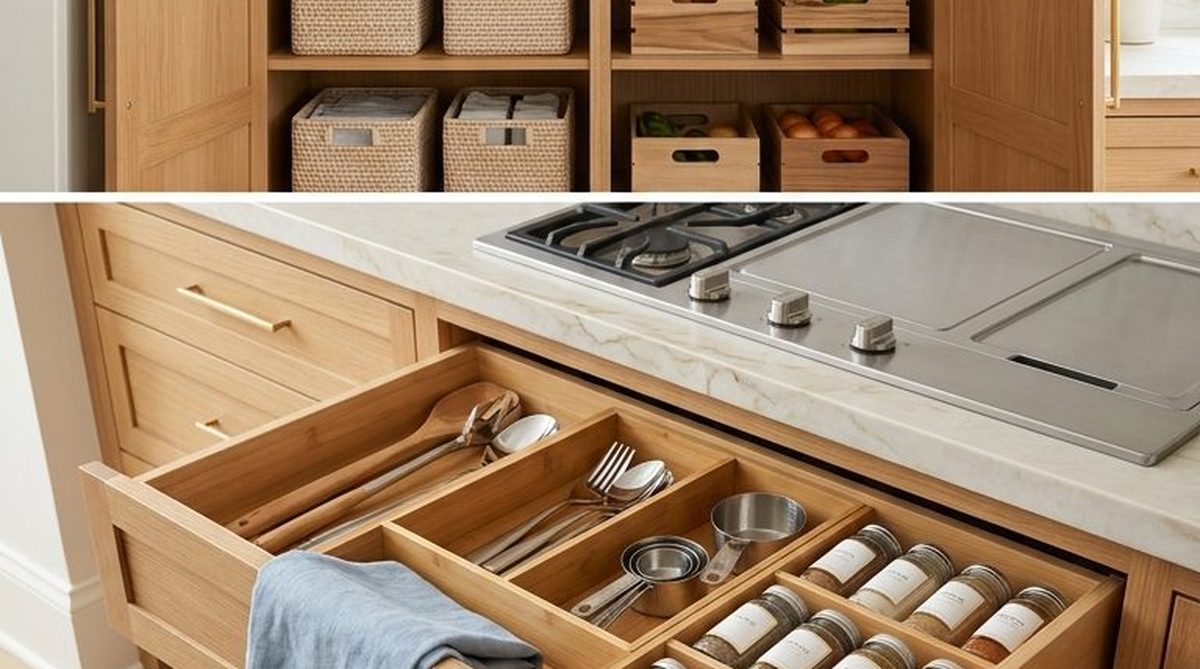
A pantry that keeps working after the organizer leaves. More in Pantry Organization Ideas That Actually Stay Organized.
Ready for Premium Service?
Explore our luxury home organization packages and see what sets us apart.
Book Your Luxury Consultation
The Real Difference: Systems Versus Spaces
Standard organizing solves a space. Premium organizing solves an operation.
That distinction sounds like marketing until you see what it means in practice.
A standard project produces an organized pantry. Everything has a place, it's labeled, it looks good. Six months later it's drifted, because nothing changed about how groceries get put away or who's responsible for restocking.
A premium project produces an organized pantry plus the zone logic written down, the labels in the languages the household actually reads, a current inventory, a defined restocking owner, and a documented reset routine. Six months later it still works, because the system was designed to be run by the people who live and work there.
The test is simple: does it survive without the organizer, and without you personally holding it together? That's what the premium tier is actually charging for, and it's the only justification for the price difference that holds up.

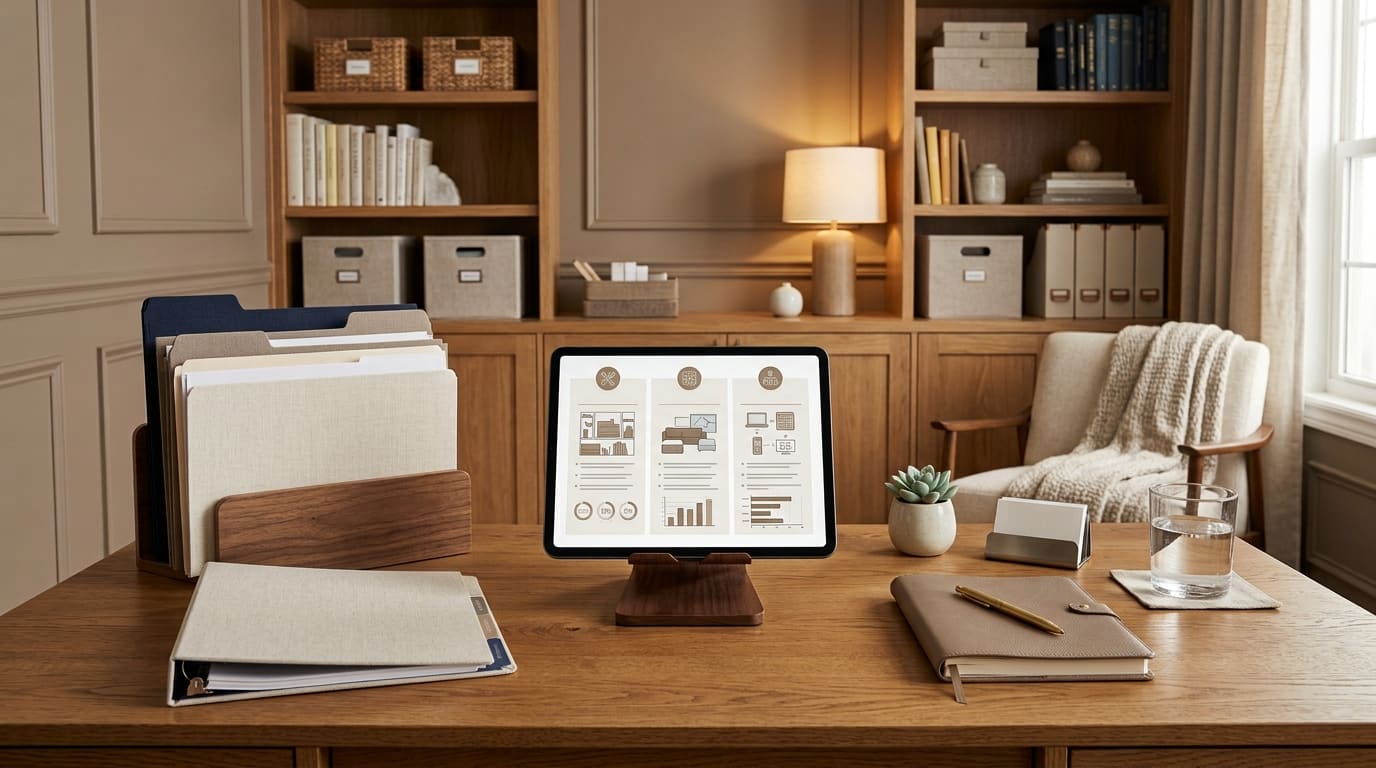
The planning happens before anyone arrives. More in What Is A Household Management System.
What Premium Actually Includes
Genuine project management
Larger projects involve more than organizing. They involve sequencing, vendors, deliveries, and coordination across days or weeks.
A premium engagement means someone owns that: the schedule, the sourcing, the delivery windows, the contractor who's installing the closet system, the disposal of what's leaving. You get a point of contact, not a series of decisions.
Custom sourcing and fitting
Standard service typically means a trip to a container store and whatever fits approximately.
Premium means measuring properly, sourcing to those measurements, and, where it's warranted, commissioning custom solutions. It also means the organizer absorbs the wrong-size problem rather than handing it to you as a return trip.

Measured and fitted, not approximately sized. More in How To Declutter Your Home Without Feeling Overwhelmed.
Discretion as a stated term
For households with any degree of privacy concern, this is not a soft benefit.
A premium engagement should come with explicit confidentiality: written into the agreement, extended to every person on the team, and covering what's seen as much as what's said. No photographs without written permission. No identifying details in marketing. Team members briefed before they enter the house.
Ask about this directly. How it's answered tells you a great deal, a firm that hasn't thought carefully about confidentiality hasn't worked with clients who needed it.

Discretion is written into the agreement, not assumed. More in What Access Should Your Household Staff Actually Have.
Working with household staff
This is the clearest dividing line, and it's the one most organizing content ignores entirely.
If your home employs staff, a housekeeper, a nanny, a house manager, kitchen help, then organizing that doesn't account for them is organizing that will fail. They're the ones maintaining it daily.
Premium service means:
- Consulting the staff before designing, because they know where the friction actually is
- Written procedures, not verbal instruction given once
- Bilingual labels and documentation where the household needs it. If your staff read Spanish more comfortably than English, English-only labeling produces errors that get attributed to the person rather than to the system, which is both unfair and unfixable
- Training the people who'll run it, not just handing over a finished space

Written procedures, and the people who will use them. More in How to Train Household Staff to Maintain Home Standards.
Multiple properties
A second home, a seasonal property, or a family compound is a different problem from one house organized well.
It requires consistency, the same zone logic, the same labeling scheme, the same procedures in every location, so anyone moving between them isn't relearning. It also requires inventory that spans properties, so you know what's where without a phone call.
Standard service organizes each house separately and leaves you to reconcile them. Sorted & Stocked was built partly for this: property-level separation with a shared standard, so multiple homes run on one system rather than several.

The same standard in every home. More in Managing Multiple Properties Without Duplicating the Work.
Kosher and dietary requirements
For a kosher home, separation isn't a preference to accommodate, it's a structural requirement the entire kitchen design has to serve.
Premium service means designing the cabinets, drawers, counters, dish storage, and fridge around the separation, with coding that means the same thing everywhere in the house and is legible to a guest or a new employee. It also means the organizer knows the difference between a design question and a halachic one, and routes the second to your Rav rather than answering it.
An organizer who improvises here will produce something that looks fine and doesn't hold.

Separation designed into the layout from the start. More in How Professional House Managers Prepare for Shabbos & Yom Tov.
Documentation you keep
The deliverable at the end of a premium project should include more than the space.
- Zone maps and the logic behind them
- Written procedures for maintaining each area
- An inventory with locations and current counts
- Product specifications, so replacements match
- Photographs of how things are set up, for reference
This is what makes the work durable. Without documentation, the system lives in whoever was present during the project, and that's a dependency, not a system.

The documentation is part of what you keep. More in How To Create A Pantry Inventory System.
Aftercare
The premium tier should include some form of return. A check-in after a few weeks. A seasonal reset. Support when something changes.
Organizing degrades. Everyone's does. The difference between a firm that expects that and one that doesn't is the difference between a service and a photograph.

Aftercare is what makes it last. More in Weekly Cleaning Schedule For Busy Families.
Want to See Our Work?
See examples of our premium organizing packages and transformations.
See Our Premium Organizing Packages
What You're Actually Paying For
Rates in this field vary enormously by market, scope, and specialization, and any specific figure quoted in an article will be wrong somewhere. What's more useful is understanding what drives the difference.
Time on site is the smallest component of a premium engagement. The larger components are:
- Planning before anyone arrives. Assessment, floor plans, zone design, sourcing decisions
- Sourcing and procurement. Finding products that fit, ordering, receiving, returning what doesn't work
- Team rather than individual. More people, coordinated, finishing in days rather than weeks
- Documentation. Written procedures take real hours and don't look like organizing while they're happening
- Staff training. Time spent with the people who'll maintain it
- Aftercare. Built into the engagement rather than sold separately
- Specialization. Kosher kitchens, multi-property households, high-security or high-privacy environments, and staffed homes are genuinely narrower expertise
The honest framing: you're paying for the parts that don't photograph. If a proposal is priced at a premium and consists only of on-site hours, you're paying premium rates for standard service.
When Premium Is Worth It, and When It Isn't
I'd rather you not hire the wrong tier than hire mine.
It's genuinely worth it when
- You employ household staff. The return here is immediate and large, because documented systems convert help that needs supervision into help that reduces your workload
- You run more than one property. Consistency across homes isn't something you can improvise
- Your kitchen has structural requirements, kosher separation, serious allergies, medical dietary needs
- You've hired an organizer before and it didn't hold. That's usually a documentation and delegation failure, not a container failure
- The project is genuinely large. Whole-home, a move, an estate, a renovation return
- Your time has a high opportunity cost and the project would otherwise sit undone for another year
- Privacy matters to you in a way a standard engagement wouldn't address
It's not worth it when
- You need one closet done. Hire an hourly organizer. Genuinely
- You're renting short-term. Systems built for a space you're leaving don't travel
- You're not ready to let go of things. No tier of service survives that, and premium just makes it more expensive
- You'd enjoy doing it yourself. Some people do, and there's no reason to buy it
- The real problem is volume, not organization. Decluttering first will change what you need, and may change it enough that you don't need this tier at all
Anyone who tells you the premium tier is right for everyone is selling. It's right for a specific set of situations, and most of them involve other people, staff, properties, or requirements, rather than budget alone.
How to Evaluate a Premium Organizer
Ask these, and pay attention to how readily each is answered.
"What's included beyond the on-site hours?" If the answer is nothing, it isn't premium.
"What do I have at the end?" Look for documentation, procedures, and an inventory, not just photographs.
"How do you handle confidentiality?" Should be immediate, specific, and written into the agreement.
"Have you worked with household staff?" And then: how do you involve them, and what do you leave them?
"What happens in six months?" Aftercare should be part of the answer, unprompted.
"Do you work in bilingual households?" If your home needs it, this is a hard requirement rather than a nice extra.
"Have you worked with kosher kitchens?" And if so: how do you handle questions that are halachic rather than practical? The right answer routes them to your Rav.
"Can I speak to a client with a household like mine?" Discretion may limit this, and a good firm will explain how they handle it rather than either refusing flatly or being casual about privacy.
Signals to be wary of
- Pricing that won't be committed to in writing
- No contract or scope document
- Photography assumed rather than asked about
- Pressure to book immediately
- A portfolio of only empty, styled spaces, that's staging, not systems
- Vagueness about who is actually in your house on the day
The Part That Actually Determines the Outcome
However good the organizer, the durable result depends on something they can't install: whether the household's information stops living in one person's head.
That's what the documentation is for. It's what the staff training is for. It's what the inventory and the written procedures are for. Organizing the physical space is the visible half; the other half is making the space runnable by someone other than you.
That's the same principle behind a full household management system, and the reason the best outcome of a premium project isn't a beautiful pantry, it's a home that runs itself when you're not there.
Frequently Asked Questions
What makes a luxury home organizer different from a standard one?
Scope and durability rather than aesthetics. A premium engagement includes planning and floor-plan work before anyone arrives, custom sourcing and fitting, written procedures and inventories you keep, training for household staff who'll maintain the space, explicit confidentiality terms, and aftercare. Standard service organizes the space; premium service produces a system that survives without the organizer.
Is a luxury home organizer worth the cost?
It's worth it when you employ household staff, run more than one property, have structural kitchen requirements like kosher separation, or have hired an organizer before and watched the work drift. It isn't worth it for a single closet, a short-term rental, or a household that mainly needs decluttering, an hourly organizer serves those better.
What should be included in a premium organizing package?
Look for pre-project planning and zone design, sourcing and procurement handled for you, a team rather than an individual, written documentation covering zone logic and maintenance procedures, an inventory with locations and current counts, staff training where relevant, and a defined aftercare visit. If a premium price buys only on-site hours, it isn't a premium package.
Do luxury organizers work with household staff?
The good ones treat it as central rather than incidental, because staff are the people who maintain the space daily. That means consulting them during design, leaving written procedures rather than verbal instruction, providing bilingual labels and documentation where the household needs it, and training them on the system before the project closes.
How do premium organizers handle privacy and confidentiality?
Through explicit written terms in the agreement, extended to every team member entering the home, covering both what is seen and what is discussed. No photography without written permission, and no identifying details in marketing. Ask about this directly, how readily a firm answers indicates whether they've worked with clients who required it.
Can a luxury organizer work with a kosher kitchen?
Only if they have real experience with it, since separation is a structural design requirement rather than a preference to accommodate. The design has to carry the separation across cabinets, drawers, counters, dish storage, and the refrigerator, with coding consistent throughout the home. A qualified organizer will also route halachic questions to your Rav rather than answering them.
How do I choose between an hourly organizer and a premium package?
Match the tier to the problem. Hourly suits a single space, a defined small project, or a household where one person will maintain the result. A premium package suits whole-home work, multiple properties, staffed households, and any situation where the system needs to be operated by people other than you, that last one is the real dividing line.
---
Ready for a Home That Works For You?
The premium question isn't really about how much you spend. It's about whether what you buy is a space or a system, and whether the people who actually run your home were part of designing it.
That's the work we do: zones built around your household's real traffic, documentation and bilingual procedures your staff can run, inventory that spans properties, and a kitchen designed to hold its separation without anyone having to think about it.
- ✓ Professional Organizing, whole-home, multi-property, and staffed households
- ✓ Moving & Unpacking, set up correctly the first time, documented from day one
- ✓ Household Management, procedures, schedules, and bilingual SOPs
- ✓ Ongoing Support, the aftercare that decides whether any of it lasts
Related Reading


Sort + Place is a professional organizing and household management practice serving families in Lakewood, New Jersey and the surrounding tristate area.
Want this running in your own house?
We build the systems, label the shelves and train the people who keep it all going.
Book Your Consultation