October 26, 2026
Refrigerator Organization: The Complete Guide
The fridge is the only storage space in your house where being disorganized doesn't just cost you time, it costs you money and it can make people sick.
Something goes behind something else. It stops existing. Three weeks later you find it, and it goes in the trash. Meanwhile you bought a second one, because you couldn't see the first. And the raw chicken has been sitting on the top shelf above the salad greens the whole time.
Refrigerator organization solves all three problems at once, visibility, waste, and food safety, and unlike most organizing projects, it takes about ninety minutes and costs almost nothing.
This guide covers where things actually belong and why, the temperature rules that matter, how to set up produce drawers so greens last, and the weekly routine that keeps it from reverting.
Want an Organized Fridge?
Download our Fridge Organization Guide with templates and maintenance schedules.
Temperature First: The Rules That Matter
Before you move a single item, get the settings right. Placement decisions only make sense once you understand that a refrigerator is not one temperature.
The two numbers
Keep the refrigerator at or below 40°F (4°C) and the freezer at 0°F (-18°C). This is standard U.S. food safety guidance from the USDA, and the reason is specific: bacteria multiply rapidly in the range between 40°F and 140°F.
Buy a fridge thermometer. Built-in displays are frequently inaccurate, and a $7 thermometer is the cheapest food-safety purchase available.
Your fridge has zones, and they're not equal
- Door, warmest. Temperature swings every time it opens.
- Top shelf, warm and stable.
- Middle shelves, consistently cool.
- Bottom shelf, coldest.
- Drawers, humidity-controlled, temperature similar to the shelves around them.
Nearly every placement rule below follows from this single fact.
Don't overfill
Air needs to circulate. A packed fridge has warm pockets, which means some of your food isn't actually being kept at the temperature the display claims. Aim for roughly three-quarters full.
Where Everything Actually Goes
Door, condiments only
The door is the warmest, most temperature-variable part of the fridge. It suits foods with preservatives and high acidity.
Yes: ketchup, mustard, jams, pickles, salad dressings, most sauces, water bottles.
No: milk and dairy. No: eggs.
Yes, most fridges have a molded egg holder in the door. It's a design convention, not food-safety advice. Eggs need consistent temperature, which the door doesn't provide. Keep eggs in their original carton on a middle shelf, the carton also protects them and carries the date.
Milk in the door is the single most common fridge mistake. It spoils measurably faster there.
Top shelf, ready-to-eat
Warmest of the shelves, so nothing that needs deep cold or poses a cross-contamination risk.
Put here: leftovers, drinks, prepared foods, yogurt, ready-to-eat items.
Leftovers go at the front, at eye level. This is a small change with an outsized effect, leftovers pushed to the back are leftovers you throw away. Use clear containers so you can see what they are without opening them.
Middle shelves, dairy and eggs
The most consistent temperature in the fridge.
Put here: milk, cheese, yogurt, butter, eggs in their carton.
Bottom shelf, raw meat, poultry, and fish
The coldest shelf, and critically, the lowest. This is the single most important placement rule in the entire fridge.
Raw meat goes on the bottom in a sealed container or on a tray, so that if anything leaks it cannot drip onto food below. There is nothing below the bottom shelf except the drawers, which are enclosed.
Never store raw meat above produce or ready-to-eat food. This is the most common cause of preventable cross-contamination in home kitchens.
Drawers, humidity control
Most fridges have two drawers with adjustable vents. The vent controls humidity, and it genuinely matters.
High humidity (vent closed), for things that wilt: Leafy greens, herbs, broccoli, cucumbers, peppers, green beans.
Low humidity (vent open), for things that rot: Apples, pears, stone fruit, avocados, melons.
Why the split: the low-humidity drawer lets ethylene gas escape. Apples, pears, avocados, and stone fruit release ethylene as they ripen; leafy greens and broccoli are highly sensitive to it and deteriorate fast in its presence. Keeping them separated is the reason your greens go slimy in four days when they should last ten.
What doesn't belong in the fridge at all
- Whole tomatoes, cold destroys the texture and flavor
- Potatoes, onions, and garlic, cool, dark, dry, and separate from each other
- Bananas, until they're ripe
- Bread, refrigeration accelerates staling; freeze it instead
- Honey, it crystallizes
- Uncut melon, counter until cut, then fridge
Need Kitchen Help?
Our kitchen organization services include complete fridge and pantry systems.
Book Your Kitchen Organization Service
Building the System
Placement is the rule set. Zones are what make it survive other people.
Set up zones with clear bins
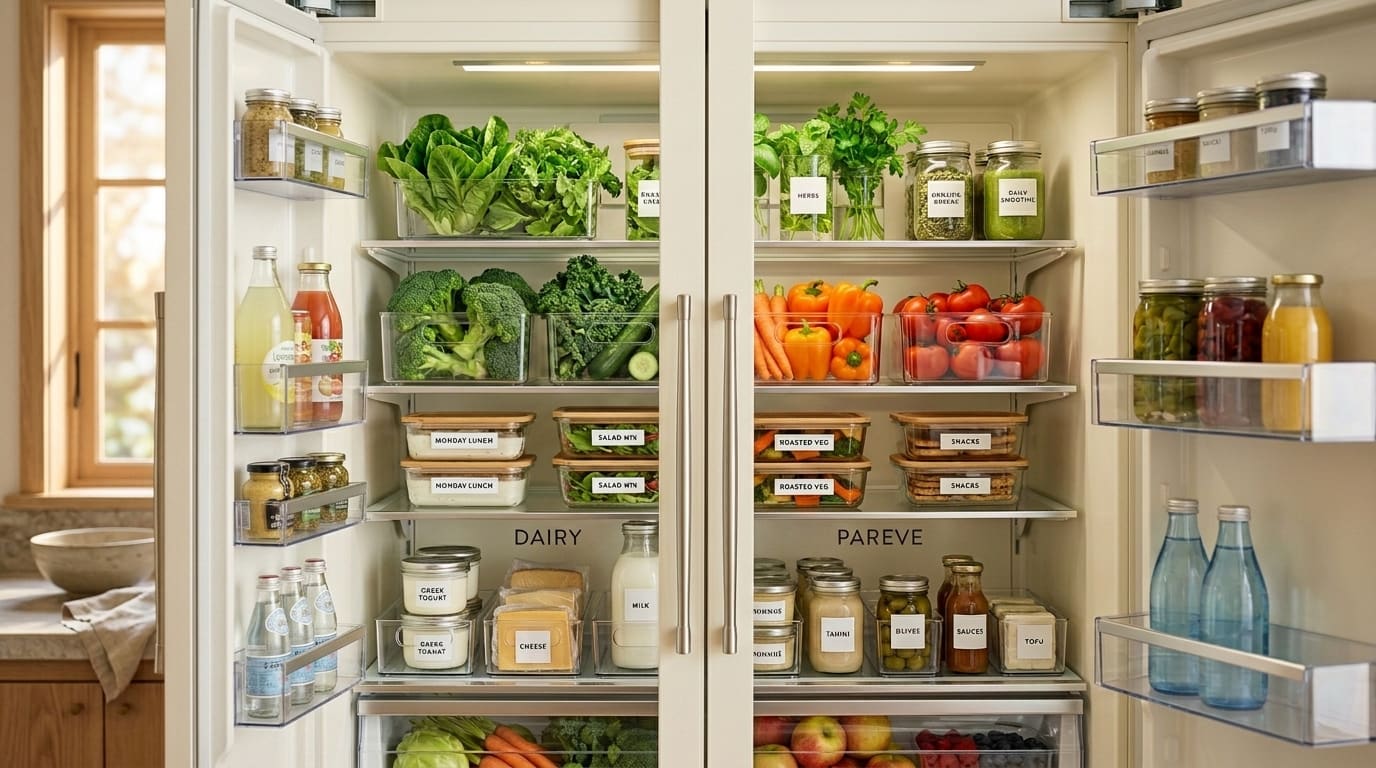
Bins do in a fridge exactly what they do in a pantry: create boundaries and make categories legible.
Useful zones for most households:
- Breakfast, yogurt, spreads, breakfast items in one bin, pulled out as a unit
- Snacks, a low bin the kids can reach independently
- Lunch supplies, cheese sticks, deli, prepared components
- Leftovers, one defined bin at the front of the top shelf, so nothing hides
- Meat and fish, a contained tray on the bottom shelf
- Drinks, door or a designated shelf area
Clear bins only. An opaque bin in a fridge is a place things go to expire.
Label the zones
Same principle as anywhere else: if someone else unloaded the groceries, could they put everything away correctly? If not, the system lives in your head and degrades every time you're not the one doing it.
Label bilingually if the people maintaining your kitchen read Spanish more comfortably than English. In a fridge this matters more than usual, because misplacement here has food-safety consequences rather than just tidiness ones.
Fridge zones in a kosher kitchen
The separation needs to be visible in the fridge, not just in the cabinets. Practical approaches: dedicated shelves by designation with the top-to-bottom order fixed and labeled, consistent color coding on bin fronts matching whatever you use elsewhere in the kitchen, and separate contained trays so nothing touches across designations.
Note that the raw-meat-on-the-bottom rule and your separation scheme both need to hold at once, plan the shelf assignments so they don't conflict. Any question about status after a spill or a mistake goes to your Rav.
First in, first out
New groceries go behind older stock. Every time. Ten seconds per item, and it prevents most of the expiration waste on its own.
Make leftovers visible and dated
Clear containers, a piece of tape with the date, and a fixed location at the front of the top shelf.
Undated leftovers are food you'll throw away, because nobody wants to gamble on something of unknown age. As a general working guideline, most cooked leftovers are good for about three to four days refrigerated, but date them so you're not guessing.
The Maintenance Routine
Weekly, before you shop, ten minutes
1. Pull anything past its point 2. Consolidate duplicates and near-empty containers 3. Wipe any spills 4. Move older items to the front 5. Note what's low for the shopping list 6. Return anything in the wrong zone
Doing this before shopping rather than after is what makes it work, you shop knowing what you actually have, which cuts duplicate buying and gives you space to put the new groceries away properly.
Monthly, thirty minutes
- Remove shelves and drawers and wash them
- Check the door seals; a failing gasket costs energy and raises the internal temperature
- Verify the thermometer reading
- Vacuum the condenser coils a few times a year
The habit that matters most
Empty containers get washed, not returned to the fridge. An almost-empty jar sitting in the door is occupying prime space and creating the impression you still have some. This single habit prevents a surprising amount of duplicate buying.
Common Refrigerator Mistakes
1. Milk and eggs in the door. Warmest, most variable spot. Fix: milk and eggs on middle shelves, eggs in their carton.
2. Raw meat above other food. Drip risk onto ready-to-eat items. Fix: bottom shelf, contained, always.
3. Overfilling. Blocks circulation and creates warm pockets. Fix: about three-quarters full.
4. Everything in one drawer. Ethylene from fruit destroys greens. Fix: high humidity for greens, low for fruit.
5. Leftovers at the back. Invisible means wasted. Fix: front of the top shelf, clear containers, dated.
6. Never checking the actual temperature. Built-in displays drift. Fix: an inexpensive thermometer.
7. Opaque containers. Fix: clear everything, or label the front.
8. No FIFO. New stock in front means old stock expires behind it. Fix: new goes behind, every time.
Frequently Asked Questions
What temperature should my refrigerator be?
Keep your refrigerator at or below 40°F (4°C) and your freezer at 0°F (-18°C), per USDA food safety guidance. Bacteria multiply rapidly between 40°F and 140°F, so this threshold matters. Use a separate fridge thermometer, since built-in displays are often inaccurate.
Where should I store eggs and milk in the fridge?
Store both on a middle shelf, not in the door, the door is the warmest and most temperature-variable part of the fridge, and milk spoils noticeably faster there. Keep eggs in their original carton, which protects them, maintains more consistent temperature, and carries the date.
Where should raw meat go in the refrigerator?
Always on the bottom shelf, in a sealed container or on a tray. It's the coldest location and, more importantly, the lowest, so any leak can't drip onto food stored below. Raw meat stored above produce or ready-to-eat food is the most common cause of preventable cross-contamination in home kitchens.
How do I use the humidity drawers in my fridge?
Set one drawer to high humidity (vent closed) for items that wilt, leafy greens, herbs, broccoli, cucumbers, and the other to low humidity (vent open) for items that rot, such as apples, pears, avocados, and stone fruit. The low-humidity setting lets ethylene gas escape, and keeping ethylene-producing fruit away from ethylene-sensitive greens is why properly stored greens last far longer.
How do I organize a fridge to reduce food waste?
Use clear labeled bins by category, keep leftovers in one dated bin at the front of the top shelf, practice first-in-first-out by putting new groceries behind old stock, and do a ten-minute clear-out before every shopping trip. Food waste in a fridge is almost entirely a visibility problem, things you can't see are things you'll re-buy and then throw away.
How often should I clean out my refrigerator?
Do a ten-minute pass weekly before shopping, remove expired items, consolidate duplicates, wipe spills, and move older items forward. Once a month, remove and wash the shelves and drawers, check the door seals, and verify the temperature. Vacuum the condenser coils a few times a year.
What foods should not be stored in the refrigerator?
Whole tomatoes, potatoes, onions, garlic, unripe bananas, bread, honey, and uncut melon all do better outside the fridge. Cold damages tomato texture and flavor, refrigeration accelerates bread staling, and honey crystallizes. Store potatoes, onions, and garlic in a cool dark dry place, and keep onions and potatoes separate from each other.
---
Ready for a Home That Works For You?
The fridge is the fastest organizing win in any house. Ninety minutes, almost no cost, and it pays back weekly in food you don't throw away and groceries you don't buy twice.
It also connects to everything else. A fridge you can see into makes meal planning systems actually work, and it pairs with pantry organization to give you a full picture of what's in the house before you shop.
- ✓ Professional Organizing, kitchens, pantries, and fridges set up as one system
- ✓ Moving & Unpacking, new kitchen organized correctly from day one
- ✓ Household Management, restocking routines and bilingual SOPs for staff
- ✓ Ongoing Support, the maintenance layer that keeps it working
Related Reading

Sort + Place is a professional organizing and household management practice serving families in Lakewood, New Jersey and the surrounding tristate area.
Want this running in your own house?
We build the systems, label the shelves and train the people who keep it all going.
Book Your Consultation