
October 25, 2026
Best Containers for Kitchen and Pantry Organization
Walk down the storage aisle and you'll find four hundred options, all of them attractive, none of them labeled with the only information that matters: whether it fits your shelf and whether you'll actually keep using it.
Most container purchases fail for one of two reasons. They don't fit, bought without measuring, returned or shoved in a cabinet. Or they add friction, a lid that has to come off every time, a canister that has to be refilled after every grocery trip, and within a month the bags are stacked on top of the beautiful empty jars.
The best containers for kitchen organization aren't the prettiest ones. They're the ones that survive contact with a Tuesday.
This guide covers what to buy for each specific job, what to skip, the measurements to take before you shop, and how to tell the difference between a container that earns its space and one that just looks like it does.
Want the Container Guide?
Download our free Kitchen Container Guide with size charts, brand recommendations, and where to buy.
Before You Buy Anything
Two rules, both non-negotiable, and skipping either is why most container purchases go wrong.
1. Declutter first
Buying storage for things you should have removed is the most common way to spend money and end up with the same kitchen. You'll buy for the volume you have rather than the volume you need, which means buying more and bigger than necessary.
Purge first. Then measure. Then buy.
2. Measure everything
Write these down before you shop, all of them:
- Shelf depth, front to back
- Shelf height, the clearance between one shelf and the next
- Shelf width
- Drawer interior dimensions, width, depth, and depth to the underside of the counter above
- Door clearance, if you're considering door-mounted racks
- Cabinet opening width, which is often narrower than the interior
A container an inch too deep sticks out and stops the door closing. A container an inch too short wastes the space behind it permanently.
Take the measurements to the store on your phone. Estimating from memory in an aisle is how the return trip happens.
Containers by Job
Match the container to the specific job. That framing does more than any brand comparison.
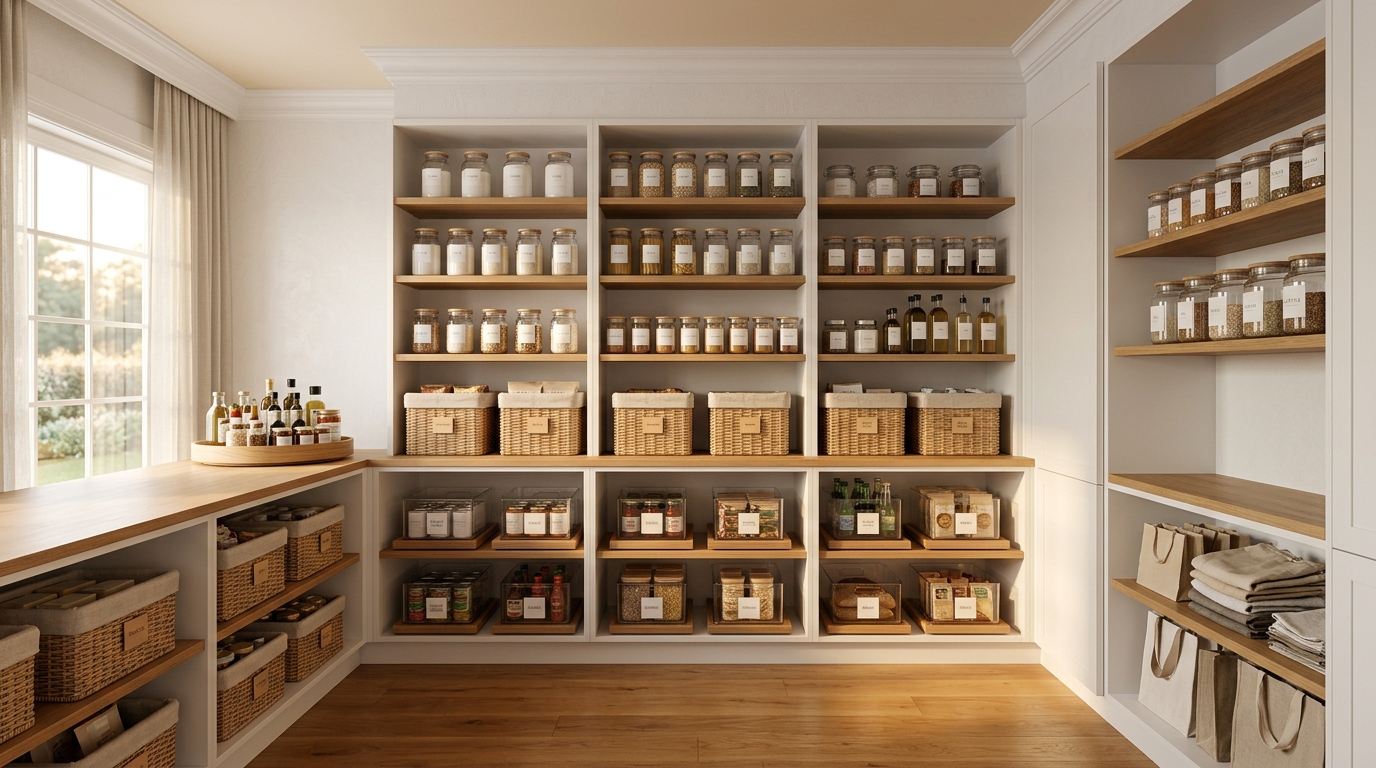
Open bins, the highest-value purchase in most kitchens
The job: creating category boundaries.
Everything in the "baking" bin is baking. When the bin is full, that category is at capacity, a built-in signal to stop buying. Pull the whole bin out, use what you need, put it back.
What to look for: - Depth matched to your shelf, not deeper - Handles, if it sits above eye level, since you'll be pulling it down blind - Open tops for anything high-turnover, lids add friction, and friction is what kills systems - Clear, or a labeled front. An opaque unlabeled bin becomes a place things go to be forgotten
Where they earn their space: pantry categories, under-sink supplies, fridge zones, snack stations.
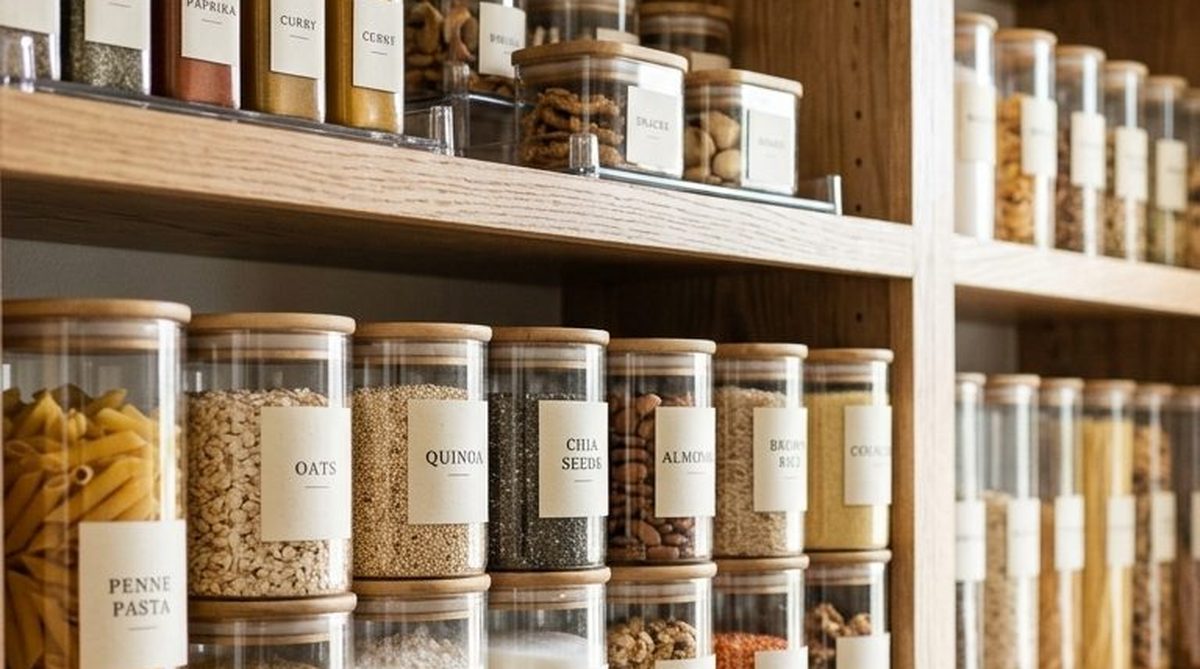
Airtight canisters, for dry staples only
The job: protecting food and making quantity visible.
Genuinely worth it for flour, sugar, rice, oats, and pasta. Bags tip, tear, can't be stacked, and hide how much is left.
What to look for: - Square or rectangular, not round. Round canisters waste roughly 20 percent of shelf space to the gaps between them - Genuinely airtight, a gasket seal, not just a snug lid - Wide mouths you can get a measuring cup into - Stackable, if your shelves are tall - Uniform sizing across the set, so they tessellate
Be honest about the refill cost. Every canister means every grocery trip now ends with a pouring step. Some households do this happily for years. Others do it for two weeks. If you're in the second group, buy four canisters, not twenty, that's useful self-knowledge, not a failure.
Tiered shelf risers, for anything in rows
The job: making the back row visible.
Canned goods, spices, short jars. Without a riser, the back two rows don't exist and you re-buy what's already there.
Cheap, and among the highest-return purchases in any pantry.
Lazy Susans, for bottles and jars
The job: eliminating reaching.
Oils, vinegars, condiments, corner cabinets. Turns a two-hand excavation into a spin.
Look for a raised lip so bottles don't walk off, and measure the cabinet's opening, a turntable that fits the interior but not the doorway is a problem you discover at home.
Drawer dividers, the best return per dollar
The job: stopping a drawer from becoming a pile.
An undivided utensil drawer is a search every single time. A divided one is a reach.
Expandable spring-loaded dividers adapt to most drawers and don't require exact measurements, which makes them the forgiving option. Fixed-tray inserts look better and require precise measuring.
Where they earn their space: utensils, cooking tools, food wraps, junk drawers, bathroom drawers.
Vertical dividers, for flat things
The job: storing things that are miserable stacked.
Sheet pans, cutting boards, pot lids, serving platters. Stacked flat, retrieving the bottom one means moving all of them.
One of the most satisfying fixes in any kitchen, and consistently underused.
Under-shelf baskets, free vertical space
The job: recovering the dead air above short items.
Most cabinet shelves have four to six inches of unused clearance above whatever's on them. A basket that hooks over the shelf reclaims it without any installation.
Door-mounted racks, for small, light items
The job: using a surface you're not using.
Spices, wraps, foil, cleaning supplies.
Measure clearance first. This is the category with the highest rate of "doesn't fit", the rack has to clear whatever's on the shelf when the door closes.
Fridge bins, clear only
The job: grouping in a space where invisibility means waste.
Breakfast items, snacks, lunch supplies, one dedicated leftovers bin at the front.
Clear is not optional in a fridge. An opaque bin is where food goes to expire.
Need Kitchen Help?
Our team sources and installs all organizing products for you. See our kitchen packages.
See Our Kitchen Organization Packages
What to Skip
Round canisters for square shelves. The gaps between circles are wasted space you paid for.
Anything requiring two hands to open for a daily-use item. You will stop using it.
Full matching sets bought upfront. Buy for the specific problem you've identified. Sets get bought for aesthetics and then half of them don't fit anything.
Containers without labels. The container isn't the system, the label is. An unlabeled bin becomes miscellaneous within a month.
Storage for things you're keeping out of guilt. Now you've paid twice.
Specialty single-purpose organizers, the dedicated taco holder, the egg tray, the one-item gadget. They consume shelf space for a narrow job.
Fabric bins in a pantry. They absorb spills, hold odors, and sag once loaded. Fine for linens, poor for food.
Materials, Honestly
Clear plastic (BPA-free), lightweight, inexpensive, visible contents, doesn't shatter. The default for most household use. Can stain and scratch over time.
Glass, attractive, doesn't stain or hold odors, easy to clean. Heavy, breakable, and a poor choice for anything stored above shoulder height.
Bamboo and wood, attractive for drawers and open shelves. Not airtight, and doesn't do well with moisture.
Metal and wire, durable and airy, good for produce and under-shelf baskets. Not airtight.
Fabric, soft, collapsible, good for linens and pantry overflow of non-food items. Not for food storage.
The practical answer for most kitchens: clear plastic for the working storage, glass for the few things sitting out where they're seen, and drawer dividers in whatever material you like since they're never holding food directly.
Where to Spend and Where to Save
Worth spending on: - Drawer dividers, used daily, forever - Airtight canisters for staples, a poor seal defeats the purpose entirely - Lazy Susans, cheap ones stick and wobble, and you'll stop spinning them
Fine to save on: - Open bins, a bin is a box with sides; the expensive ones aren't better at that - Shelf risers, simple mechanics - Under-shelf baskets, same - Fridge bins, they need to be clear and washable, nothing more
A functional pantry can be outfitted for under $100 with bins, risers, and a label maker. The photogenic versions cost several times that, and the difference is almost entirely appearance rather than function.
Labeling: The Part That Makes Containers a System
A container without a label is storage. A container with a label is a system.
The test: if someone else unloaded your groceries, could they put everything away correctly? If not, the system lives in your head and degrades every time you're not the one doing it.
- Label the category, not the item. "Baking" outlasts "Flour + Sugar", contents shift, categories don't
- Readable from standing distance. If you have to lean in, it's too small
- Same position on every container. Your eye learns the pattern
- Date anything decanted. A canister of flour with no date is flour of unknown age
- Label bilingually if your household needs it. If the people maintaining your kitchen read Spanish more comfortably than English, an English-only label guarantees errors that get blamed on the person rather than on the label
A Sensible Buying Order
Don't buy everything at once. Add in this order, and only continue if the previous step is still working after a month.
1. Drawer dividers, immediate daily improvement, hard to get wrong 2. Open bins for pantry categories, creates the structure everything else sits inside 3. A label maker or good labels, makes steps 1 and 2 into a system 4. Tiered risers, solves the invisible back row 5. Lazy Susan for oils, vinegars, and the corner cabinet 6. Airtight canisters for your top four or five dry staples, only if you're genuinely willing to decant 7. Vertical dividers for sheet pans and lids 8. Under-shelf baskets and door racks for whatever's still cramped
Most kitchens are dramatically better after steps 1 through 4, which together cost well under a hundred dollars.
Frequently Asked Questions
What are the best containers for kitchen and pantry organization?
Open bins with handles do the most work in most kitchens because they create category boundaries without adding friction, followed by drawer dividers, tiered shelf risers, and Lazy Susans. Airtight square canisters are worth it specifically for dry staples like flour, sugar, rice, and oats. Measure your shelves and drawers before buying anything.
Should I decant everything into containers?
No. Decant high-turnover dry goods that come in bags, flour, sugar, rice, oats, pasta, and leave canned goods, infrequently used items, and anything whose cooking instructions you need. Every decanted item adds a pouring step to every grocery trip, so only take on that cost where it genuinely pays off.
Are glass or plastic containers better for pantry storage?
Clear BPA-free plastic is the practical default: lightweight, inexpensive, visible, and it won't shatter if dropped from a high shelf. Glass doesn't stain or hold odors and looks better on open shelving, but it's heavy and breakable, which makes it a poor choice for anything stored above shoulder height.
How much should I spend on kitchen organizing containers?
A fully functional pantry can be outfitted for under $100 using open bins, tiered risers, drawer dividers, and labels. Spend on drawer dividers, airtight canisters with real gasket seals, and quality Lazy Susans; save on open bins, risers, and fridge bins, where expensive versions perform no better.
What size containers do I need for my pantry?
That depends entirely on your shelf dimensions, which is why measuring comes before shopping. Record shelf depth, the clearance between shelves, and shelf width, plus your cabinet opening width, which is often narrower than the interior. A container an inch too deep will stop a door closing.
Why do round canisters waste space?
Circles don't tessellate, the gaps between round containers on a rectangular shelf are unusable, costing roughly 20 percent of the surface. Square or rectangular containers sit flush against each other and the shelf edges, which is why they're the better choice anywhere space is constrained.
Do I need labels if my containers are clear?
Yes, because labels do a different job than visibility. A clear container shows what's inside; a label tells everyone else where it belongs when it's time to put things away. Without labels, the system exists only in the head of whoever set it up and degrades whenever someone else unloads the groceries.
---
Ready for a Home That Works For You?
Containers are tools, and tools only help inside a system. The bins matter far less than the decision about what each zone holds and whether anyone else can read the labels.
That's the part we do, the zones, the labels, the sourcing and the fitting, so nothing arrives that doesn't fit and nothing gets bought for things that should have gone.
- ✓ Professional Organizing, measured, sourced, installed, and labeled
- ✓ Moving & Unpacking, a new kitchen set up correctly the first time
- ✓ Household Management, restocking systems and bilingual SOPs for staff
- ✓ Ongoing Support, the maintenance layer that keeps it working
Related Reading

Sort + Place is a professional organizing and household management practice serving families in Lakewood, New Jersey and the surrounding tristate area.
Want this running in your own house?
We build the systems, label the shelves and train the people who keep it all going.
Book Your Consultation