October 13, 2026
Smart Pantry Management: The Future Of Home Organization
For about a century, the pantry has worked exactly one way: you open the door, you look, you remember, you guess. The technology is the door.
Everything else in the house got smarter. Your thermostat learns your schedule, your doorbell recognizes packages, your washing machine texts you. Meanwhile the room holding several hundred dollars of food you paid for still requires you to stand in front of it and squint.
Smart pantry management is the correction, using scanning, tracking, and shared data so your household knows what it has without anyone having to look. Not a gadget, and not a smart fridge with a screen in the door. A system where the information about your food exists somewhere other than one person's memory.
This guide covers what smart pantry management actually means today, what the technology genuinely does versus what it's marketed as doing, where it's heading, and how to adopt it without buying anything you'll abandon in a month.
What Smart Pantry Management Actually Means
Smart pantry management is the practice of tracking your food inventory digitally, what you have, how much, where it is, and when it expires, so the information is available to everyone in the household, from anywhere, without opening a door.
That's the whole definition. Notice what isn't in it: no sensors, no cameras, no appliance purchase required.
The "smart" part is the shared, queryable record, not the hardware. This distinction matters enormously, because the hardware is what gets marketed and the record is what delivers the value.
The three capabilities that define it
1. Visibility without physical access. You're in a store aisle. You need to know if you have paprika. Smart pantry management means you check your phone instead of buying a fourth jar.
2. Automatic thresholds. The system tells you you're low before you're out. You stop discovering shortages at the moment you need the thing.
3. Shared state. Your spouse, your kids, and anyone who helps in your home all see the same information. Nobody is texting a photo of a shelf to ask whether to buy more rice.
What it replaces
The current system in most homes is: one person holds a rough mental model of the pantry, and that model is consulted by everyone else via text message. It degrades constantly, it can't be delegated, and it fails entirely when that person isn't reachable.
That's the actual problem. Not disorganization, centralization.
The Technology, Honestly Assessed
Here's what genuinely works today, what's overpromised, and what's still mostly a demo.
Working well now: barcode scanning
Point your phone at a package, and the item is identified and added. This is the single most important feature in smart pantry management, and it's mature.
Why it matters more than it sounds: the failure mode of every inventory system is entry friction. If adding an item takes thirty seconds of typing, the system goes stale within three weeks. If it takes two seconds of scanning, it survives.
Coverage is good for packaged goods with UPCs and poor for anything you buy loose, in bulk, or from a store that repackages, which in a kosher household is a meaningful share of the food. Expect a mix of scanning and manual entry.
Working well now: shared access and roles
Multiple people, one record, updated in real time. Role-based permissions mean staff can update counts without administrative access to everything else.
This is unglamorous and it's where most of the actual value sits, particularly in households with help.
Working well now: expiration tracking and alerts
Enter a date once, get warned before it passes. Straightforward, reliable, and it addresses one of the largest sources of household food waste, U.S. federal estimates from the USDA and EPA have consistently found food waste to be a substantial share of the food supply, with households responsible for a large portion of it.
The mechanism in a real kitchen is simple: something goes behind something else and stops existing until it's expired. A dated record fixes that.
Overpromised: smart refrigerators
Internal cameras and screens have been marketed as the future of kitchen inventory for over a decade. In practice:
- Cameras see the front row only
- Nothing in a drawer or behind another item is visible
- The appliance replacement cycle is measured in decades, so the software ages badly
- The price premium is significant relative to the function delivered
A $12 barcode-scanning app on a phone you already own outperforms a camera-equipped fridge for actual inventory purposes. That may change; it hasn't yet.
Still emerging: weight sensors and smart shelves
Sensor mats that detect when a container's weight drops below a threshold. The concept is sound, genuinely automatic tracking with zero user input.
The current reality: expensive, fiddly to calibrate, limited to containers that sit on the sensor, and defeated the moment someone puts the box down in a different spot. Promising, not ready.
Still emerging: image recognition
Photograph a shelf, have software identify everything on it. Improving quickly, still unreliable for the specific case that matters, partially obscured items, similar packaging, items behind other items.
Worth watching, not worth waiting for.
The honest summary
The valuable, working technology in smart pantry management today is: fast scanning, shared access, thresholds, and expiration dates. All of it runs on a phone. None of it requires new appliances.
Curious About Smart Homes?
Learn about smart home systems and how they simplify household management.
Learn About Smart Home Systems
What Smart Pantry Management Solves
Duplicate purchases
Every household re-buys things it already owns. Spices are the classic case, but it runs through every category. Each purchase is small; the annual total isn't.
A phone-checkable record eliminates this without requiring anyone to be more disciplined.
Food waste
Food you can't see is food you'll throw away. Visibility plus expiration alerts addresses the actual mechanism rather than exhorting people to be more careful.
The lookup-service problem
This is the one that matters most in a busy household. When only one person knows what's in the house, that person becomes a service, answering texts from the store, being called at work, personally rebuilding the shopping list every week.
A shared pantry record redistributes that, and it's the difference between a household where one person is the database and one where anyone can query it.
Staff coordination
If you employ household help, the inventory question is operational. Who decides what to restock? How do they report that something's out? What happens when the person who knows the kitchen is off?
Without a shared record, the answer is always "the owner handles it", which defeats a meaningful part of why the help exists.
Planning
Once the pantry is legible, meal planning stops being aspirational. You plan from what's in the house rather than from what sounds good and then discovering you're missing two ingredients at 6 p.m.
Where This Is Actually Heading
Reasonable near-term expectations, without the marketing.
Integration, not more devices
The meaningful direction isn't smarter pantries, it's pantries connected to everything downstream. Inventory that feeds the shopping list, which feeds the meal plan, which feeds back into inventory when you cook.
Most current tools solve one link in that chain and hand you a disconnected result. The next useful step is closing the loop, which is a software problem rather than a hardware one.
Receipt and order ingestion
Digital receipts and online grocery orders already contain a structured list of everything you bought. Parsing that automatically, rather than scanning each item, is the most obvious available improvement and requires no new hardware at all.
Better prediction
Once a system has a few months of your household's data, it can reasonably infer consumption rates and predict shortages before thresholds are hit. This is unremarkable technology applied to a domain that hasn't had it.
Multi-property and multi-user as standard
Currently a rarity. Households running a second home, a storage area, or several people with different responsibilities are poorly served by tools built for one person cataloging their own belongings.
What probably won't happen soon
- Fully automatic tracking with no human input
- Reliable camera-based recognition of a full pantry
- Smart appliances becoming the primary interface
Bet on your phone, shared data, and better integrations. Don't bet on the fridge.
Adopting It Without Wasting Money
The failure pattern is consistent: buy the tool, spend a weekend cataloging, abandon it in week five. Here's how to avoid that.
Start with the problem, not the product
Which is actually costing you? Duplicate buying, running out, food waste, or the fact that only you know what's in the house?
Different problems point to different features. Buying for all four at once produces a setup project you won't finish.
Don't catalog your house
Start with fifteen to thirty items, the staples you genuinely re-buy. Under an hour.
Then add items as you buy them, not in a cataloging session. Unloading groceries becomes the entry point, and within a month your real inventory exists, built in increments small enough that you barely noticed.
The items you never add are the items you never buy, which means they didn't belong in the system.
Prioritize entry speed above everything
When evaluating any tool, time yourself adding one item. If it's more than a few seconds, it won't survive contact with a real week. Every other feature is secondary to this one.
Get everyone on it in week one
Not after you've "finished setting it up." A system introduced to others once it's complete gets treated as your system. One built with them from the start belongs to the household.
If staff maintain your kitchen and read Spanish more comfortably than English, the tool must be bilingual. An English-only interface in that situation generates errors that get attributed to the person rather than to the software.
Attach maintenance to something existing
Two minutes weekly, attached to unloading groceries or your weekly planning session. Unattached maintenance doesn't survive.
Don't buy hardware yet
No sensors, no smart appliances, no dedicated scanners. Your phone does the working parts. Revisit hardware when it's demonstrably better, not when it's newly marketed.
The physical layer still matters
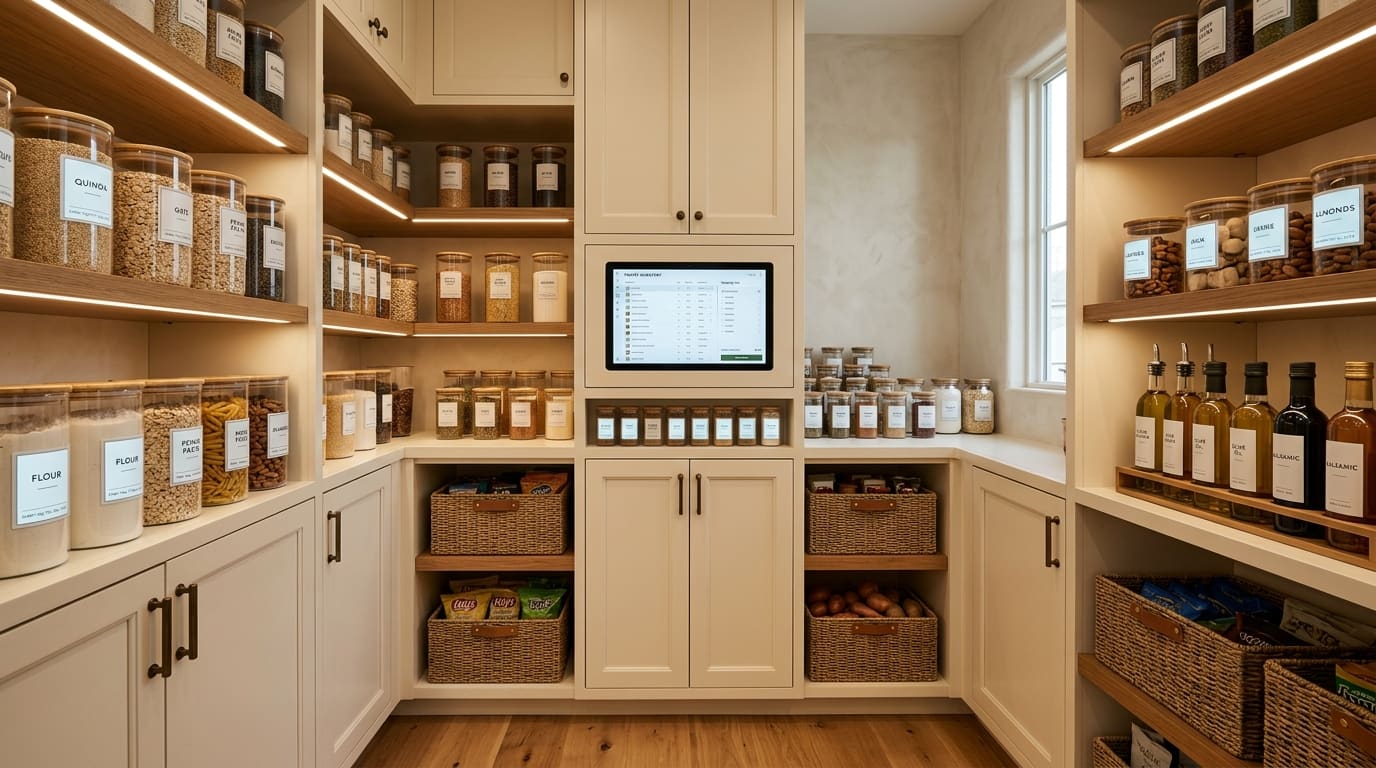
Software doesn't fix a shelf you can't see into. A well-zoned, labeled pantry makes scanning and counting fast; a chaotic one makes it miserable enough that you'll do it once. If the physical setup isn't sorted, kitchen organization comes first, and the manual version of a pantry inventory system is worth building before any app.
Frequently Asked Questions
What is smart pantry management?
Smart pantry management is tracking your food inventory digitally, what you have, how much, where it is, and when it expires, so the information is shared across your household and accessible from anywhere. The "smart" element is the shared, queryable record rather than any particular hardware; it typically runs entirely on a phone.
Do I need a smart refrigerator for smart pantry management?
No. Smart refrigerator cameras see only the front row and can't detect items in drawers or behind other things, while the appliance replacement cycle means the software ages badly. A barcode-scanning app on the phone you already own delivers considerably more practical value at a fraction of the cost.
How does barcode scanning work for pantry inventory?
You point your phone camera at a product's barcode and the app identifies it and adds it to your inventory, usually in a couple of seconds. Coverage is strong for packaged goods with standard UPCs and weaker for bulk, loose, or repackaged items, so expect to combine scanning with occasional manual entry.
Can smart pantry management reduce food waste?
Yes, because most household food waste comes from a visibility failure, something goes behind something else and isn't found until it's expired. Expiration tracking with alerts and a record you can check without opening the door address that mechanism directly, rather than relying on anyone remembering.
Is smart pantry management worth it for a small household?
It depends on the problem you're solving. If you're one or two people and the only issue is occasional duplicate buying, a written list on the pantry door may be enough. The return scales sharply with the number of people who need the same information, households with children, staff, or multiple properties benefit most.
What's the difference between a pantry app and smart pantry management?
A pantry app is a tool; smart pantry management is the practice, which includes the physical organization that makes tracking feasible, agreed thresholds for restocking, shared access for everyone who uses the kitchen, and a maintenance habit. An app without those things produces an inventory that goes stale within weeks.
Will smart pantries become fully automatic?
Not in the near term. Weight sensors and image recognition are both improving but remain unreliable for the cases that matter, items behind other items, similar packaging, containers moved off a sensor. The realistic near-term progress is in software integration: receipts and grocery orders feeding inventory automatically, and inventory feeding shopping lists and meal plans.
---
Ready for a Home That Works For You?
The future of pantry management isn't a screen in your fridge door. It's the boring, genuinely useful version: a shared record everyone in your household can see, updated in seconds, connected to what you're planning to cook and what you're about to buy.
That's what Sorted & Stocked was built for, inventory, meal planning, shopping, and staff task systems in one place, with role-based access and full bilingual support, designed for households where several people need the same information at once.
- ✓ Professional Organizing, the physical layer that makes tracking possible
- ✓ Moving & Unpacking, inventory built as the new kitchen is set up
- ✓ Household Management, restocking systems and bilingual SOPs for staff
- ✓ Ongoing Support, the maintenance layer that keeps the record accurate
Related Reading


Sort + Place is a professional organizing and household management practice serving families in Lakewood, New Jersey and the surrounding tristate area.
Want this running in your own house?
We build the systems, label the shelves and train the people who keep it all going.
Book Your Consultation