August 20, 2026
Meal Planning Systems For Busy Families
It's 5:15. Someone asks what's for dinner. You open the fridge, look at it for a while, close it, and open it again, as though the second look might produce a different answer.
You're not disorganized. You're being asked to make a fresh decision, under time pressure, at the hour of the day when your capacity for decisions is lowest, about a task that also requires ingredients you may or may not have.
A meal planning system removes that decision, not by making you more disciplined, but by moving the deciding to a calmer moment and making it smaller. Twenty minutes on Sunday instead of twenty-one separate decisions across the week.
This guide covers the frameworks that actually hold up in busy households, why planning from a recipe list fails, how to connect planning to what's already in your kitchen, and how to keep the whole thing running when a week goes sideways.
Want Easy Meal Planning?
Download our Meal Planning Template with weekly planners and shopping lists.
Why Most Meal Planning Fails
Almost everyone has tried this and stopped. The reasons are consistent and none of them are about willpower.
It was too ambitious
Someone plans fourteen distinct meals, each requiring shopping and prep, several of which the family has never eaten. It works for nine days and collapses.
A plan built for the household you wish you were will fail. Build for the one you have, on your actual worst weeknight.
It ignored what was already in the house
The most common failure mode: you plan from recipes, build a shopping list from the plan, and buy four things you already owned while missing two you needed. Then Wednesday's meal can't be made and the whole plan unravels from there.
Planning has to start from inventory, not from inspiration.
It had no flexibility
A rigid Monday-through-Friday plan meets one late meeting and breaks. If the plan can't absorb a bad day, one bad day ends it.
It required too many decisions anyway
"Plan seven dinners" is still seven decisions on a blank page. The plan didn't reduce the deciding, it just moved it to Sunday and made Sunday worse.
The fix for all four is the same: constrain the choices before you plan.
The Framework: Themed Nights
This is the highest-return meal planning structure for busy families, and it's free.
Assign each night a theme, protein, or format. Not a fixed menu, a frame that eliminates the blank page.
A working example:
- Monday, chicken
- Tuesday, fish
- Wednesday, meat
- Thursday, pasta, or make-your-own night
- Friday, the standing Shabbos menu
- Sunday, leftovers, or something deliberately easy
Within each night you still choose the dish, but you're choosing from four options rather than infinite. Planning drops from twenty minutes to five, and the shopping list becomes predictable, which is what makes bulk buying, inventory tracking, and delegating the shopping actually work.
Why this works better than a rotating menu
A fixed rotating menu, the same seven meals every week, reduces decisions to zero but produces revolt within a month. Themed nights keep variety inside a structure, which is the balance most families need.
Build the themes around your real week
- Put the easiest theme on your hardest day. If Tuesday is the night with three pickups, Tuesday is not the night for a braise.
- Put anything requiring real prep on a day you're home earlier.
- Leave one night deliberately unplanned, leftovers, breakfast for dinner, or takeout. A plan with slack in it survives; a plan at full capacity doesn't.
The standing Shabbos menu
For households that host every week, this is doing enormous work and it deserves to be explicit.
Building the same core menu each Friday, with one or two rotating elements for variety, means the shopping, the prep sequence, and the timing all become known quantities rather than a weekly project. You stop re-solving the same problem fifty-two times a year.
It also makes the week's planning easier, because Friday is already answered before you start.
Start From What You Have
This is the step that separates a plan that works from a plan that generates emergency store runs.
The order that works
1. Check the inventory first. What's in the pantry, the fridge, the freezer? 2. Build the plan around what's already there, starting with anything that needs using up. 3. Then list what's missing. 4. Then shop.
Most people do this backwards, plan, shop, discover duplicates. Reversing the order eliminates most duplicate buying immediately and cuts food waste, because you're actively planning to use what's about to turn.
You need something to check
This is where meal planning depends on a pantry inventory system. It doesn't need to be elaborate, a laminated list of your staples on the pantry door works completely for a lot of households.
What it needs to be is current. Planning from a stale inventory is worse than planning from none, because you'll build a plan around rice you don't have.
The "use it up" slot
Give one meal a week explicitly to whatever needs using, the vegetables going soft, the half bag of something, the leftovers that need a second life.
This one habit does more for food waste than any container purchase, and it removes a meal from the planning burden at the same time.
Building the Weekly Planning Session
Twenty minutes, once a week, same slot. This is the engine.
When
Whenever suits, but tie it to shopping. Most households land on Sunday morning or Thursday evening. The requirement is that it happens before the shopping, not after.
The sequence
1. Check the calendar. Which nights are late? Is anyone out? Any guests? This determines what's realistic before you plan a single meal. 2. Check the inventory. What's here, what needs using. 3. Fill the themes. One dish per night, from the frame. Five minutes. 4. Build the shopping list, from the gaps between the plan and the inventory, plus anything that is running low. 5. Note the prep. Anything needing thawing, marinating, or advance work goes on the calendar as its own item. 6. Post the plan where the family can see it.
Post it where people look
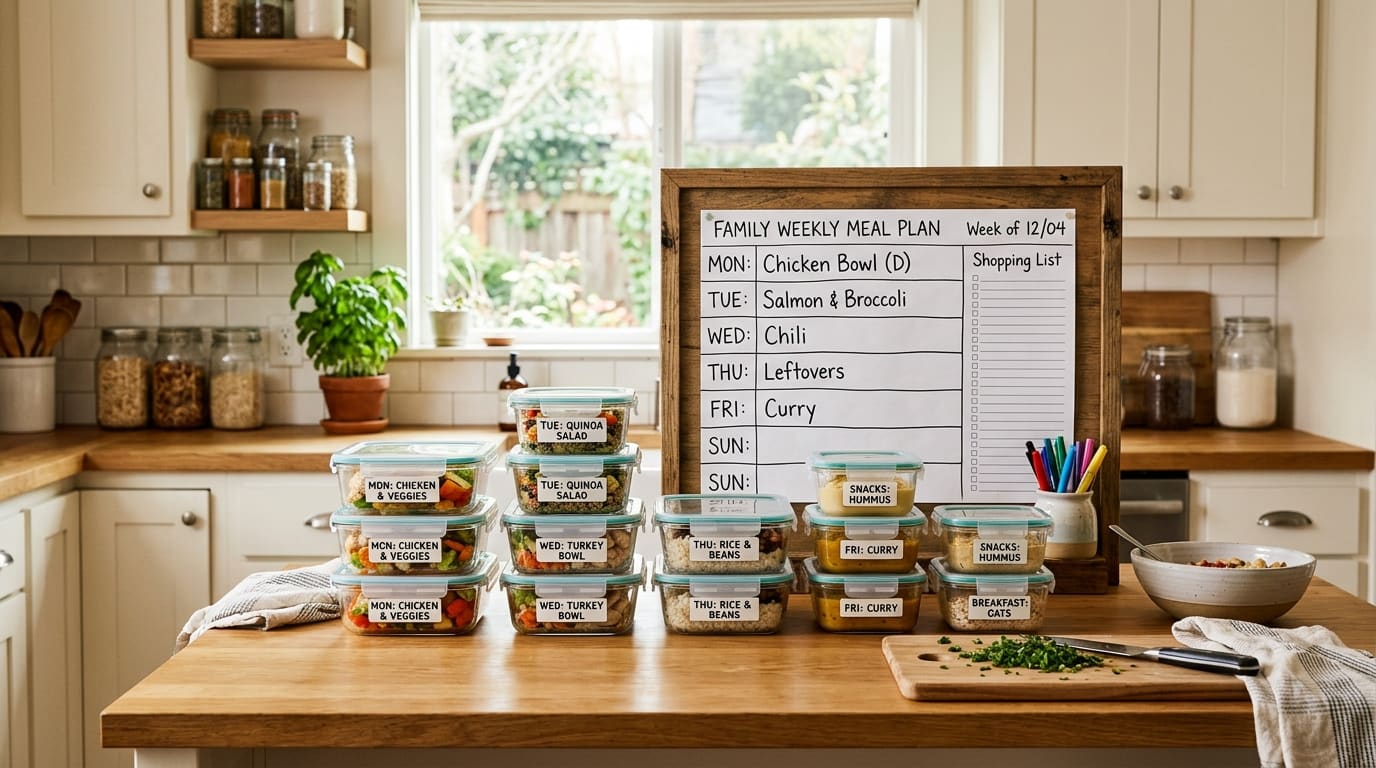
A meal plan in your head or your phone still leaves you as the answer service. On the fridge or the family command center, it answers the question before anyone asks it.
This is a small change with a disproportionate effect, the 5:15 question stops being asked at all.
Ready for Smart Planning?
Join Sorted & Stocked for integrated meal planning and pantry management.
Prep Strategies That Actually Fit
Full Sunday batch cooking works beautifully for some households and is entirely unrealistic for most. Here are lighter versions that hold.
Component prep, not meal prep
Instead of assembling complete meals, prepare components that appear across several:
- A large batch of rice or grains
- Roasted vegetables
- Cooked chicken, portioned
- Chopped onions, peppers, and garlic
- A base sauce
Components are more flexible than finished meals and they don't produce the day-four fatigue of eating the same thing repeatedly.
Double and freeze
When you cook something that freezes well, make double. One goes in the freezer.
Within about six weeks you have a genuine backup shelf, and a backup shelf is what turns a collapsed evening into a fine one rather than into takeout.
Prep the hardest night only
If full prep isn't happening, prep for one night: whichever is worst. Do that night's work on Sunday and let the rest be normal cooking.
Partial prep is not failed prep. It's the version that survives.
Fifteen minutes the night before
Look at tomorrow's meal and do one thing, take the chicken out to thaw, chop the vegetables, make the marinade. Attached to the evening reset, it costs almost nothing and removes the worst of the 5 p.m. crunch.
Making It Survive a Bad Week
Every system drifts, and meal planning drifts fastest because it collides with real life every single day.
Build in the backup
Two or three genuinely easy meals that require only shelf-stable or frozen ingredients, kept permanently stocked. Not a plan, a floor.
Knowing the floor exists is what stops one hard evening from ending the whole system.
Plan five, not seven
Leave two nights open. Leftovers, an easy standby, or something spontaneous. A plan at full capacity has no room to absorb a change, and changes are certain.
Let it be imperfect
You'll swap nights. You'll skip a planned meal. That's the system working, a plan is a starting point, not a contract with yourself.
Have a reset
When it falls apart entirely, and it will, over a holiday or an illness or a hard stretch, the way back is one twenty-minute planning session. Not a rebuild. The reset is the same as the routine.
Get other people into it
Let family members claim a night. Let older kids cook one meal a week, badly at first. Let a spouse own a night completely, including the deciding.
A system only you run degrades every time you're not available, which is precisely when a household most needs dinner to be a solved problem.
Common Meal Planning Mistakes
1. Planning without checking inventory. Produces duplicate buying and missing ingredients. Fix: inventory first, always.
2. Planning all seven nights. No slack. Fix: plan five, leave two open.
3. Too many new recipes. New recipes take longer and fail more often. Fix: one new dish a week at most, on an easier night.
4. Hard meals on hard days. Fix: check the calendar before assigning anything.
5. Not posting the plan. You stay the answer service. Fix: on the fridge or the command center.
6. No backup meals. One collapsed evening ends the system. Fix: two or three shelf-stable standbys, permanently stocked.
7. Prep goals that don't fit. All-day Sunday cooking that happens twice. Fix: component prep, or prep only the worst night.
8. Skipping the prep notes. The plan says chicken; the chicken is frozen solid. Fix: thawing and advance work go on the calendar.
Frequently Asked Questions
What is a meal planning system?
A meal planning system is a repeatable structure for deciding what your household eats, typically a weekly session where you check the calendar, check your inventory, fill a set of themed nights, and build the shopping list from what's missing. The point is to move the deciding to a calm moment and reduce the number of choices, rather than to make you more disciplined about it.
How do I start meal planning for a busy family?
Assign each night a theme, a protein or format like chicken, fish, meat, or pasta, so you're choosing among a few options rather than facing a blank page. Then hold one twenty-minute session weekly before you shop: calendar, inventory, fill the themes, build the list. Plan five nights rather than seven so the plan can absorb a bad day.
Why does meal planning never work for me?
Usually one of four reasons: it was too ambitious for your real week, it didn't start from what you already had in the house, it had no slack to absorb a disrupted evening, or it still required too many decisions on a blank page. Constraining the choices with themed nights and planning from inventory addresses all four.
Should I meal plan for a week or a month?
Weekly works for most households, because a month's plan can't account for schedule changes and becomes fiction by week two. If you want a longer horizon, keep the weekly planning session but maintain a rotating bank of dishes per theme, which gives you variety without re-deciding from scratch each time.
How does meal planning connect to grocery shopping?
The shopping list should be built from the gap between your plan and your current inventory, plus anything already running low, never from the plan alone. Checking inventory first is what eliminates duplicate purchases and lets you deliberately plan around ingredients that need using up.
How much time does meal planning take each week?
About twenty minutes once the structure exists: checking the calendar, checking inventory, filling themed nights, and building the list. The first two or three sessions take longer while you set up the themes and your staples list, after which it settles.
What should I do when the meal plan falls apart?
Use a backup, two or three genuinely easy meals made from shelf-stable or frozen ingredients that you keep permanently stocked. When the whole system lapses over a holiday or a hard stretch, the way back is simply one twenty-minute planning session; the reset and the routine are the same thing.
---
Ready for a Home That Works For You?
The 5:15 question isn't really about food. It's about being the only person who can answer it, which is the same problem showing up in the pantry, the shopping list, and every other part of running a house.
We build the whole chain: kitchen zones that make cooking possible, an inventory you can actually check, and planning routines that survive a bad week. Sorted & Stocked connects them, so what's in the house drives what you plan and what you plan drives what you buy.
- ✓ Professional Organizing, kitchens and pantries set up so planning is possible
- ✓ Moving & Unpacking, systems established from day one in a new home
- ✓ Household Management, planning routines and bilingual SOPs for staff
- ✓ Ongoing Support, the maintenance layer that keeps it running
Related Reading


Sort + Place is a professional organizing and household management practice serving families in Lakewood, New Jersey and the surrounding tristate area.
Want this running in your own house?
We build the systems, label the shelves and train the people who keep it all going.
Book Your Consultation