August 27, 2026
Kitchen Organization Ideas For Busy Families
It's 5:40 p.m. You're making dinner. Someone needs a snack, someone else needs help with homework at the counter you're trying to use, the dishwasher is clean and nobody has emptied it, and you can't find the good measuring cup because it's in the dishwasher, clean, with all the other things nobody has emptied.
The kitchen isn't messy because your family is careless. It's messy because it's the single hardest-working room in the house, cooking, eating, homework, mail, snacks, backpacks, medication, lunches, and Shabbos prep all happening in the same square footage, and it was probably never organized around any of that.
Good kitchen organization for a busy family isn't about matching containers. It's about designing the room so several people can use it at once without getting in each other's way, and so the things that happen daily require the fewest possible steps.
This guide covers zone design around real family workflow, making the kitchen genuinely usable by kids, the systems that hold up on a Tuesday, and how to keep it working when everyone's tired.
Want a Kid-Friendly Kitchen?
Download our Kitchen Organization Guide with family-friendly systems that actually work.
Start With How Your Family Actually Uses the Kitchen

Cooking, cleanup and grab and go each get their own path. Move the snacks and the paths stop colliding. how a small kitchen compresses the same zones.
Before moving a single item, spend three days noticing. Not organizing, noticing.
Watch for: - Where do people stand when they're in the kitchen together? - Where do the bottlenecks happen? Usually the sink, the fridge door, or one specific counter. - What do you reach for every single day? - What do the kids come in for, and what do they need help with that they shouldn't? - Where do things pile up? Piles are information, they show you where a category needs a home it doesn't have.
The most common finding: the items used most often are in the least convenient places, because the kitchen was arranged by what fit rather than by what's used.
The second most common finding: every single kid task requires an adult. Snacks are out of reach, cups are in a high cabinet, the water dispenser needs help. Each of those is an interruption during the hour you have the least slack.
Map your three traffic patterns
Most family kitchens have three flows, and they collide:
1. The cooking flow, fridge → prep counter → stove → serving 2. The cleanup flow, table → sink → dishwasher → cabinets 3. The grab-and-go flow, kids and adults getting snacks, drinks, and lunch items
These three should not cross. If the snack zone is inside the cooking triangle, your kids will be underfoot every time you cook, and neither of you can do anything about it.
Moving the snack and drink station out of the cooking area, even just to the far end of the counter or a dedicated low cabinet, is often the single highest-impact change in a family kitchen.
Zone Your Kitchen Around Tasks, Not Categories

Pantry beside the fridge, prep at the island, pots and spices beside the range. Everything for one job sits where that job happens. the pantry version of the same idea.
Most kitchens are organized by what things are. Plates with plates, appliances with appliances. Task zones organize by what you're doing, which means everything for one job is in one place.
The zones worth building
Prep zone. Cutting boards, knives, mixing bowls, measuring tools, peelers. Located at your main counter, near the sink.
Cooking zone. Pots, pans, cooking utensils, oils, salt and everyday spices, pot holders. Everything within arm's reach of the stove.
Baking zone. Flour, sugar, leaveners, measuring cups, mixer, sheet pans, mixing bowls. Baking is an all-at-once activity, grouping it tightly turns a fifteen-minute setup into a two-minute one.
Cleanup zone. Dish soap, sponges, dishwasher tabs, trash and recycling, dish towels. Under and around the sink.
Everyday dishes. Plates, bowls, cups, cutlery, positioned near the dishwasher, not near the table. You put dishes away far more often than you set the table, so optimize for the frequent task.
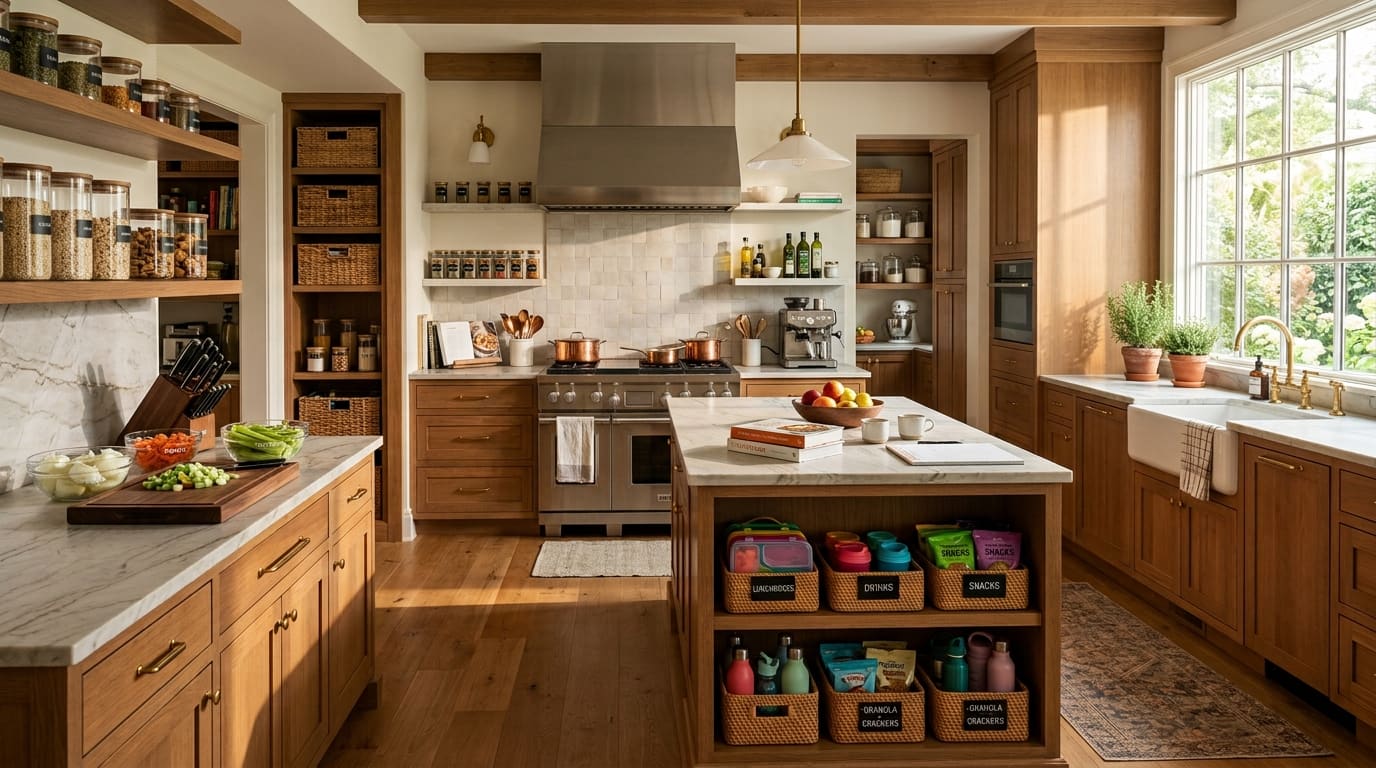
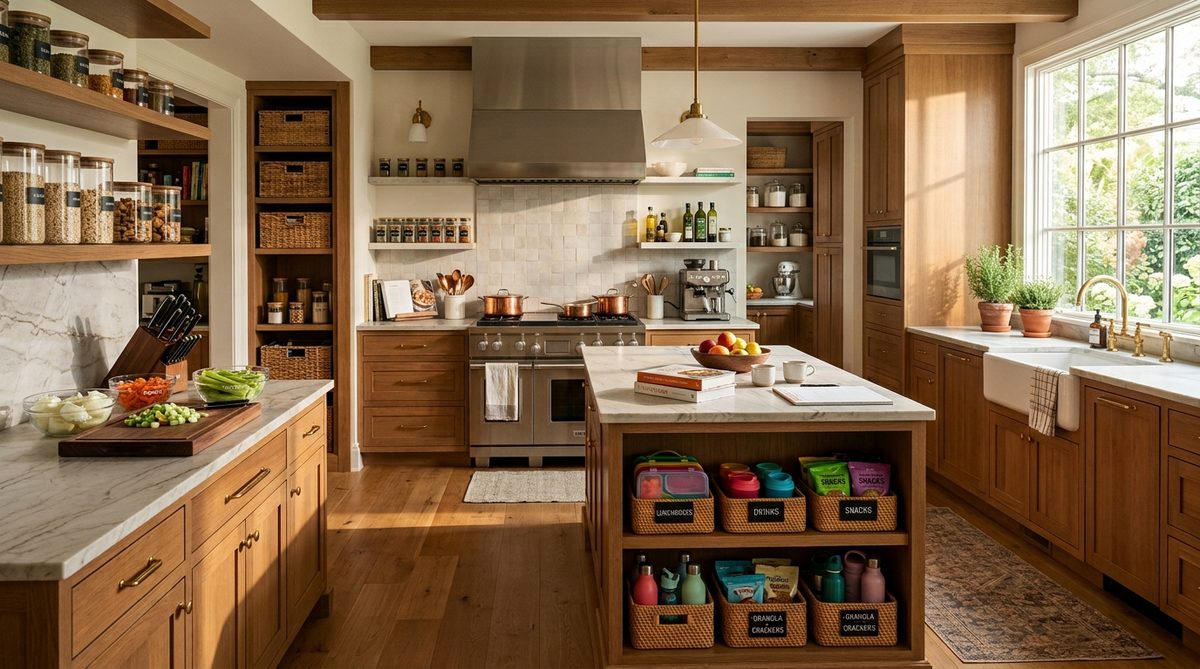
Grab-and-go zone. Snacks, water bottles, lunch supplies, kids' cups and plates. Outside the cooking triangle, at kid height.
Command zone. Where the paper lands, school forms, mail, keys, chargers. If you don't give this a home it will take the counter.
The frequency rule

Everyday plates and bowls where the hand lands, serving pieces up top. The good china can wait for the step stool. where the occasional tier goes in a small kitchen.
Within every zone, rank your storage by reach:
- Eye level to chest, daily use
- Waist to eye level, weekly use
- Low shelves, heavy items and bulk
- Top shelf and deep corners, occasional and seasonal
The most common kitchen mistake: the everyday plates on a high shelf and the good china at eye level. Reverse it. The china can require a step stool twice a year.
Zones in a kosher kitchen
If your kitchen keeps separation, the zones need to carry it visibly, not just in your head, but in a way that a guest, a helper, or a new staff member can't get wrong.
Two approaches that work:
- Vertical separation, dedicated cabinets and drawers per designation, with counters and sinks assigned and labeled.
- Color coding, one color per designation, applied consistently to labels, drawer edges, cutting boards, and bin fronts.
The critical part is that the coding means the same thing everywhere: the pantry, the fridge, the dish storage, and the drawers. A system whose meaning changes from one cabinet to the next isn't a system.
Any question about the status of specific items, kashering, or what to do after a mistake goes to your Rav, not to a labeling scheme.
Make the Kitchen Work for Kids

Cups, bowls, water and snacks on low open shelves. Now a six year old can get a snack without you. the back to school version of this station.
This is the section that changes a family's daily life most, and it's the one most kitchen advice skips entirely.
The principle: every task a child can do independently is an interruption you don't get.
Set up a self-serve station
Pick a low cabinet or a drawer, ideally outside the cooking area, and stock it with:
- Kids' cups, plates, and bowls
- Approved snacks in open bins
- Water bottles
- Napkins
Then a low shelf in the fridge with drinks, cut fruit, yogurt, and cheese sticks.
Now a six-year-old can get a snack without you. That's five to ten interruptions a day removed, most of them during the hours you can least afford them.
Use picture labels for pre-readers
A photo or simple drawing on each bin means a three-year-old can put things back. Kids follow systems reliably when the system doesn't require reading or an adult, the friction, not the willingness, is almost always what stops them.
Make putting away possible
If kids can't reach the cabinet where their dishes belong, they can't clear their own plates. Move kid dishes to a low drawer and the whole "clear your plate" instruction becomes actionable instead of aspirational.
Assign real ownership
Not "help me", ownership of a complete task:
- Emptying the bottom rack of the dishwasher
- Setting the table
- Packing their own snack for the next day
- Wiping the table after dinner
A complete task a child owns beats five tasks they assist with, because ownership includes the noticing, and the noticing is the part you're trying to hand off.
Expect 80%
Kid-organized is not adult-organized. The bin will be untidy. The plate will be in the wrong spot sometimes. That's fine, the goal is independence, not precision, and correcting them constantly costs more than the imperfection does.
Need Hands-On Help?
Our team specializes in creating kitchen systems for busy families.
Systems That Survive a Weeknight

Fifteen minutes after dinner. Dishes in, counters wiped, tomorrow staged. Every morning starts here. how the week's plan feeds the lunch staging.
Organization that only holds when everyone is calm and rested isn't organization. Here's what survives 5:40 p.m.
The landing zone
Give backpacks, mail, keys, and paperwork a defined home before they reach the counter. A hook rack, a basket per kid, a single mail tray. Without this, the kitchen counter becomes the household's default surface and stays that way.
The dishwasher rule
Pick one and hold it: either it gets emptied every morning, or it gets emptied by a named person at a named time.
The clean-dishwasher-nobody-empties problem causes more visible kitchen mess than anything else, because a full clean dishwasher means dirty dishes pile in the sink, which means the counter fills, which means there's nowhere to cook.
One rule. One owner. Every day.
Clear counters as the baseline
Counters are workspace, not storage. The only things that live on them permanently are what you use daily, probably a kettle or coffee setup, a knife block, maybe one appliance.
Everything else goes in a cabinet, even if it means taking it out three times a week. A clear counter is what makes cooking feel possible when you're tired.
The evening reset
Fifteen minutes after dinner: dishes in, counters wiped, table cleared, dishwasher started, tomorrow's lunch items staged.
This single routine changes how every morning feels. It's the highest-return habit in the entire kitchen, and it costs less than a quarter hour.
Lunch and breakfast staging
Group everything for the recurring meals in one spot. Lunch supplies, bags, containers, non-perishables, in one bin. Breakfast items on one shelf.
Morning is the worst possible time to be searching for anything, so remove the searching entirely.
Connect the kitchen to the week
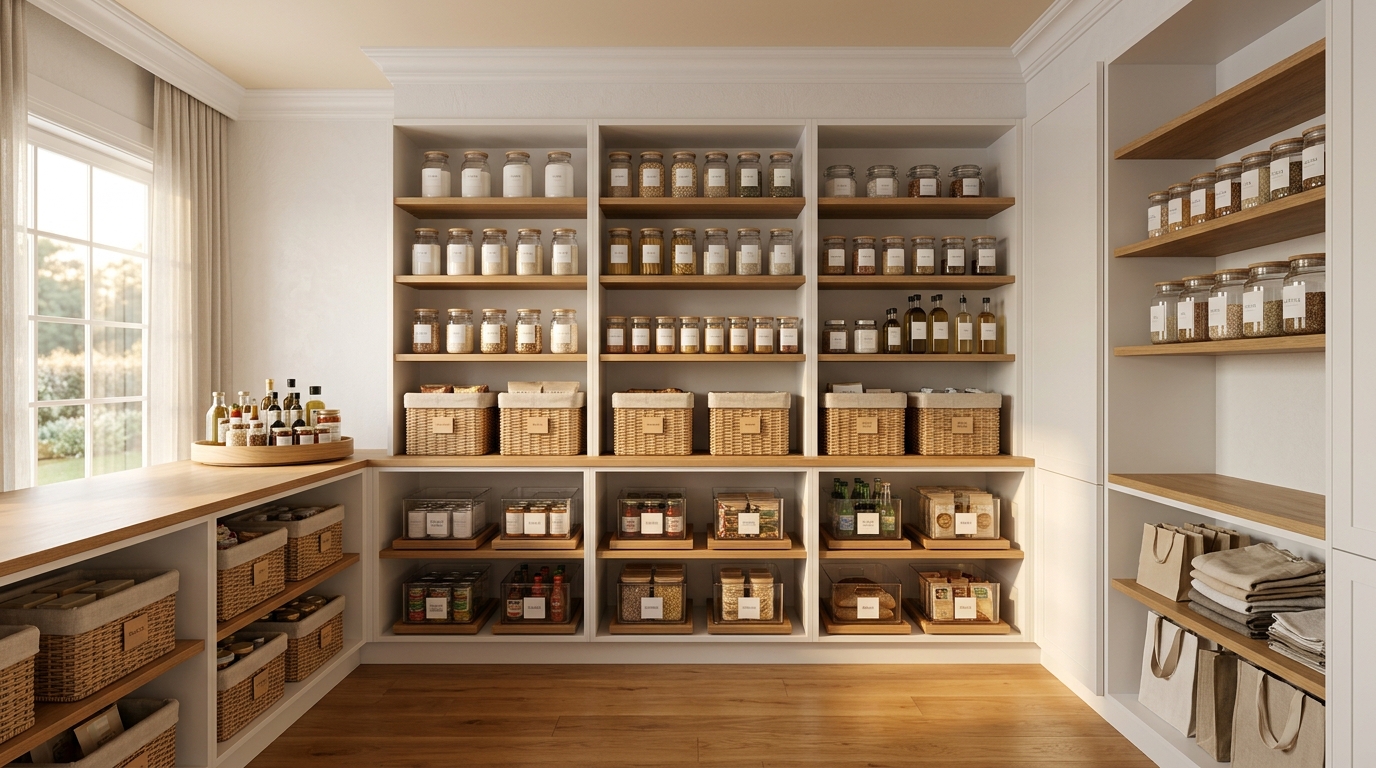
A kitchen that's organized but unstocked still generates emergency runs. The zones only pay off fully when they connect to what you're cooking and buying, which is where meal planning systems and a maintained pantry organization setup close the loop. Twenty minutes of weekly planning, one shopping list built from what's actually low.
Kitchen Organization Products Worth the Money

Dividers, risers and a lazy Susan. Measure first, declutter first, then buy only what does a job like these. the pantry version of these tools.
Not everything sold as kitchen organization earns its space. These consistently do.
Drawer dividers. The highest-return purchase in most kitchens. An undivided utensil drawer is a search every time; a divided one is a reach.
Tiered shelf risers. For cabinets with tall vertical space, spices, canned goods, short jars. Doubles usable capacity and makes the back row visible.
Lazy Susans. For corner cabinets and for oils, vinegars, and condiments. Turns a two-hand excavation into a spin.
Clear bins with labels. For grouping categories in cabinets and the fridge. The label is what makes it a system rather than a container.
Vertical dividers. For sheet pans, cutting boards, and pot lids. Stacked flat, these are one of the most frustrating categories in any kitchen.
Under-shelf baskets. Reclaim the dead air above short items in a tall cabinet.
Door-mounted racks. For spices, wraps, and cleaning supplies, where clearance allows.
Two rules before you buy
Measure first. Depth, height, and width of the actual cabinet or drawer. Returned-container trips are what stall kitchen projects for a week.
Declutter first. Buying storage for things you should have removed is the most common way to spend money and end up with the same kitchen. Do the purge, then measure, then buy.
Maintenance: Keeping It Working

Once a week, before shopping: clear what is past, wipe the shelves, note what is low and put everything back where it lives. the pantry half of the same weekly pass.
The five-minute daily pass
Beyond the evening reset, one quick circuit returning strays to their zones. Sixty seconds, and it prevents the slow drift that undoes everything.
The weekly reset
Once a week, ideally before shopping:
1. Clear the fridge of anything past its point 2. Return anything in the wrong zone 3. Wipe down surfaces properly 4. Note what's running low 5. Face labels forward
The seasonal review
Four times a year, ask whether the zones still match your life. School years change routines completely. Kids grow and can reach higher shelves. Schedules shift. The kitchen should change with them, a zone layout that fit last September may be actively wrong by March.
Teach the system, don't just build it
Everyone who uses the kitchen needs to know where things go, including a spouse, older kids, grandparents who help, and any staff.
If people are maintaining your kitchen who read Spanish more comfortably than English, label bilingually. English-only labels in that situation produce errors that get attributed to the person rather than to the labeling, which is both unfair and unfixable.
Accept drift, and have a reset
Every kitchen drifts. Holidays, illness, a hard week. Drift is normal and not a failure. What matters is having a defined way back, the fifteen-minute evening reset and the weekly pass are exactly that.
Common Kitchen Organization Mistakes

Counters are workspace, not storage. The right half is what makes cooking feel possible when you are tired. the small kitchen version of this fix.
1. Organizing by category instead of task. Everything for one job scattered across three cabinets. Fix: build task zones.
2. Buying containers before decluttering. Fix: purge, measure, then buy.
3. Prime real estate wasted on rarely used items. Fix: rank storage by reach, assign by frequency.
4. Snacks inside the cooking triangle. Guarantees kids underfoot during dinner prep. Fix: move the grab-and-go zone out.
5. Kid items out of kid reach. Every task becomes an adult task. Fix: low drawer, low fridge shelf, open bins.
6. Counters used as storage. Fix: daily-use items only, everything else in cabinets.
7. No landing zone for paper. The counter becomes the default. Fix: a defined home for mail, forms, and keys.
8. No dishwasher rule. The single biggest driver of visible kitchen mess. Fix: one time, one owner, every day.
9. Systems only one person can run. Fix: label clearly, bilingually where needed, and teach everyone.
10. Treating it as a one-time project. Fix: the daily pass and the weekly reset.
Frequently Asked Questions
What are the best kitchen organization ideas for busy families?
Build task zones rather than category storage, prep, cooking, baking, cleanup, and a grab-and-go zone positioned outside the cooking area. Set up a self-serve snack and drink station at kid height, establish one dishwasher rule with a named owner, and do a fifteen-minute evening reset. These four changes remove more daily friction than any container purchase.
How do I organize a kitchen so my kids can help?
Move kids' cups, plates, and bowls to a low drawer, stock a low fridge shelf with drinks and ready snacks, and use open bins with picture labels for pre-readers. Children follow systems reliably when the system doesn't require an adult to start it, the barrier is almost always reach and friction rather than willingness.
What should I keep on my kitchen counters?
Only what you use daily, typically a coffee or kettle setup, a knife block, and at most one appliance. Counters are workspace, and a clear counter is what makes cooking feel manageable at the end of a long day. Everything else belongs in a cabinet even if you take it out several times a week.
How do I stop my kitchen from getting messy every day?
Establish one dishwasher rule with a named owner and time, give paper and backpacks a defined landing zone before they reach the counter, and do a fifteen-minute evening reset after dinner. A full clean dishwasher nobody empties is the most common root cause of a visibly messy kitchen, because it backs up the sink and then the counters.
What kitchen organization products are actually worth buying?
Drawer dividers give the highest return in most kitchens, followed by tiered shelf risers, Lazy Susans for corner cabinets and condiments, vertical dividers for sheet pans and pot lids, and clear labeled bins. Measure your cabinets before buying anything and declutter first, since storage bought for items you should have removed solves nothing.
How do I organize a kitchen that several people use at once?
Separate the three traffic flows, cooking, cleanup, and grab-and-go, so they don't cross. Move the snack and drink station out of the cooking triangle, position everyday dishes near the dishwasher rather than near the table, and keep the main prep counter clear of anything stored permanently.
How often should I reorganize my kitchen?
Do a five-minute daily pass and a weekly reset before shopping, then review the zone layout seasonally. School years and children's ages change kitchen routines significantly, so a layout that worked in September may need adjusting by spring, the zones should follow the family rather than staying fixed.
---
Ready for a Home That Works For You?
A kitchen that works for a busy family isn't the one that photographs well. It's the one where three people can be in it at 5:40 and nobody is in anyone's way, where a seven-year-old can get their own drink, and where the counter is clear enough to actually cook on.
That's what we build, zones designed around your family's real traffic, systems your kids can run, and labeling that works for everyone who uses the room. If you want the tracking side of it too, Sorted & Stocked handles inventory, meal planning, and shopping in one shared place.
- ✓ Professional Organizing, kitchens designed around how your family actually cooks and eats
- ✓ Moving & Unpacking, new kitchen set up correctly from day one
- ✓ Household Management, routines, restocking, and bilingual SOPs for staff
- ✓ Ongoing Support, the maintenance layer that keeps it working
Related Reading

Sort + Place is a professional organizing and household management practice serving families in Lakewood, New Jersey and the surrounding tristate area.
Want this running in your own house?
We build the systems, label the shelves and train the people who keep it all going.
Book Your Consultation