
October 27, 2026
Kitchen Decluttering: How to Let Go of What You Don't Use
You know the pasta machine isn't earning its shelf. You've known for four years.
It's not that you can't see it. It's that getting rid of it means admitting something, that the version of you who was going to make fresh pappardelle on a Sunday didn't materialise, that the money is gone, that your mother-in-law will notice. So it stays, and every time you reach past it for the colander you pay a small tax you've stopped noticing.
Kitchen decluttering is rarely a knowledge problem. Almost nobody genuinely doesn't know what they use. What stops people is that kitchen items carry more than function, money, identity, obligation, and the particular guilt of food-adjacent waste.
This guide is about that part. What actually makes kitchen items hard to release, category by category, and how to decide without needing to resolve the feeling first.
Not Sure What to Keep?
Download our free Kitchen Decluttering Guide with the "Keep or Toss" decision framework.
Why Kitchen Items Are Uniquely Hard
Four reasons, and recognising which one you're facing makes the decision faster.
The money is visible
Kitchen equipment is expensive and you remember what it cost. The stand mixer, the good pans, the appliance that seemed essential.
The reframe that works: the money left when you bought it. Keeping the item doesn't recover a cent, it just adds a storage cost on top of a cost already paid. The only question left is whether it earns its space now.
It represents a version of you
The bread machine, the juicer, the tagine. Each was bought by someone imagining a particular life.
Letting go of the object can feel like conceding the life. It isn't, you can decide to bake bread next year and buy a machine then. The equipment doesn't hold the intention. You do.
Someone gave it to you
Wedding gifts are the hardest category in any kitchen. The serving dish from an aunt, the set you registered for and never used.
The reframe: the gift completed its purpose when it was given. It expressed care, and that happened. Storing something unused doesn't honour anyone, it stores obligation.
It's food-adjacent
There's a particular resistance around anything connected to feeding people. Discarding a food container feels closer to discarding food than discarding a broken lamp feels like waste.
Worth naming so you can set it aside. A cracked container is not food.
Category by Category
Work in this order. It runs easiest to hardest, which is deliberate, you'll make better decisions on the wedding china after twenty minutes of practice on plastic lids.
1. Food storage containers, start here
The easiest category in the kitchen and usually the largest volume freed.
Empty the whole cupboard. Match every lid to a base. Anything unmatched goes, both directions. Anything stained, warped, or cracked goes.
Then keep one system. Four different brands that don't stack is why the cupboard is chaos. One set that nests and stacks will use half the space.
No feelings attached, immediate visible result. It's the best possible warm-up.
2. Duplicate utensils
Count them. Six spatulas, four wooden spoons, three peelers, two whisks you use and one you don't.
Keep two of anything you use daily, one of everything else. The drawer stops being a search.
3. Chipped, cracked, mismatched
Chipped mugs, cracked bowls, the two survivors of a set of eight.
One honest question: would you serve a guest on this? If not, it's not really in your kitchen, it's occupying space in it.
4. Single-purpose gadgets
The avocado tool, the egg slicer, the strawberry huller, the garlic press you don't reach for.
Test: used in the last twelve months? If no, a knife does the job.
Exception worth respecting: if a single-purpose tool makes something you cook often meaningfully easier, it earns its place. The test is frequency, not principle.
5. Appliances you don't use weekly
Now it gets harder. Bread machine, juicer, ice cream maker, slow cooker you replaced, the second blender.
Two questions: - When did I last use this? - If I wanted to do that thing next month, would I actually?
If it's genuinely seasonal or occasional but real, keep it, and move it out of the kitchen. A labelled bin in a hall closet costs you nothing and frees prime space. That's a legitimate answer and people forget it exists.
6. Cookbooks
Photograph the handful of recipes you actually make. The books can live on a shelf elsewhere, or go.
Be honest about how you cook now. Most households moved to phones years ago and kept the shelf out of habit.
7. Wedding gifts and inherited pieces, last
By now you've made a hundred decisions and you're faster at it.
Options that aren't all-or-nothing: - Keep one piece from a set rather than the set. One teacup, used, beats twelve in a box. - Photograph it, then release it. The memory isn't in the object. - Pass it to someone in the family who'll use it, which is often easier than donating. - Use it. The good china used twice a year is doing its job; the good china in a box for twelve years isn't.
And if something is genuinely too hard right now, leave it. Box it, date it, revisit in a year. That's a decision too, and it beats forcing one you'll regret.
Need Kitchen Help?
Our kitchen organization specialists help you create a functional space you'll love using every day.
The Questions That Actually Decide It
Run in order, stop at the first clear answer.
1. Is it broken, cracked, or missing pieces? → Go. No further thought. 2. Have I used it in twelve months? → If no, strong candidate. 3. Would I buy it again today, at full price? → The sunk-cost breaker. 4. Do I have a better one? → Keep the better one. 5. Would I serve a guest on it? → Applies to anything visible. 6. If I needed it next month, could I borrow or rebuy it for under $30? → If yes, the risk of letting go is genuinely small.
Question three does most of the work, because it moves the question from what did I pay to what is this worth to me now, which is the only question that affects anything going forward.
For Kosher Kitchens
Decluttering a kosher kitchen has a dimension a general guide won't cover: you're working across multiple sets, and the volume is correspondingly higher.
Practical approach:
- Work one designation at a time, fleishig fully, then milchig, then pareve, rather than moving between them. Cleaner decisions, and no risk of mixing during the sort.
- Duplicates within a designation are still duplicates. Four fleishig peelers is four peelers.
- Yom Tov and Pesach sets are legitimately seasonal, the answer is usually contained and stored outside the kitchen, not discarded.
- Sort and label by designation as you go, so nothing gets returned to the wrong cabinet.
Any question about the status of an item, whether something can be given away, or what to do if there's been a mistake goes to your Rav. That's outside what an organizing decision can answer.
What to Do With What Leaves
Decide this before you start, or the piles just relocate.
Donate: matched sets, working appliances, unchipped dishes, unopened gadgets. Local shelters, thrift organizations, community groups, buy-nothing networks. Call ahead, many have specific lists.
Give directly: frequently faster than donating, especially for good cookware or a set someone's setting up a first home with.
Sell: only genuinely valuable items, quality cookware, working high-value appliances. Set a hard deadline; unsold in three weeks means donate.
Recycle: metal cookware often can be. Check locally.
Trash without guilt: cracked plastic, warped non-stick, anything unusable. Finding a virtuous destination for a broken colander is a delay wearing a good outfit.
Get it out of the house the same day. A donation bag in the hallway gets unpacked. Into the car, or gone.
After: Don't Refill It
A decluttered kitchen refills unless something changes about what enters it.
One in, one out for gadgets, cookware, and containers. The new pan means the old one goes.
A twenty-four hour pause on any kitchen purchase that isn't a replacement. Most wants don't survive a day.
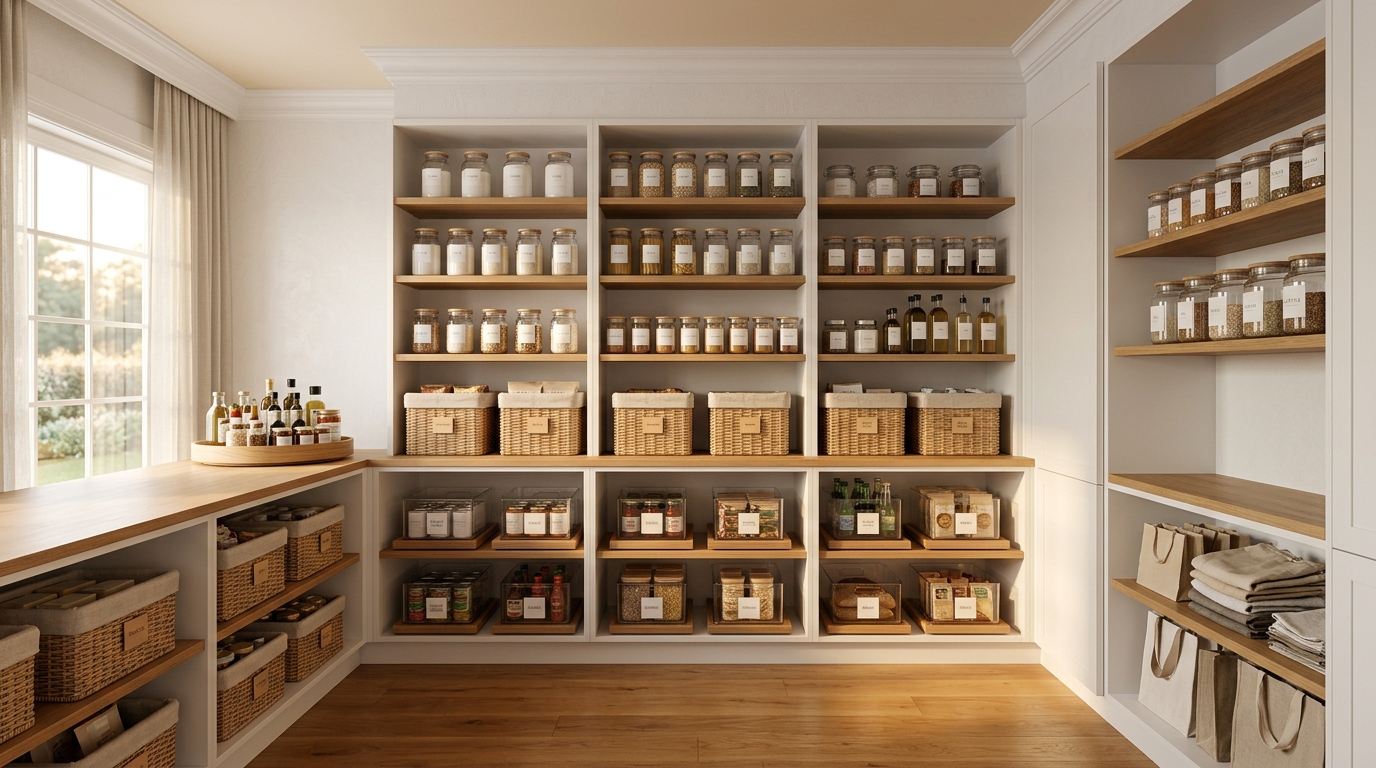
Give every remaining item a home, items without one become the next pile within weeks. That's where decluttering hands off to layout, covered in kitchen organization and, for food specifically, pantry organization.
And a five-minute weekly pass: anything that migrated goes back, anything obviously finished goes in a donation bag. Small, permanent, and it's what stops the whole thing needing doing again.
Frequently Asked Questions
Where do I start with kitchen decluttering?
Start with food storage containers, match every lid to a base and discard both orphans and anything stained or warped. It's the easiest category, carries no emotional weight, usually frees the most volume, and gives you twenty minutes of decision practice before you reach anything harder.
How do I let go of expensive kitchen equipment I don't use?
Recognise that the money left when you bought it, keeping the item recovers nothing and adds a storage cost on top. The only live question is whether it earns its space now. Ask whether you'd buy it again today at full price; if the answer is no, that's your answer.
What should I do with wedding gifts I never use?
The gift completed its purpose when it was given, it expressed care, and that already happened. Storing something unused stores obligation, not gratitude. Consider keeping one piece from a set rather than the whole set, passing it to a family member who'll use it, or photographing it before letting it go.
How do I decide which kitchen gadgets to keep?
Keep anything used in the last twelve months, plus any single-purpose tool that makes something you cook often meaningfully easier. Let go of duplicates beyond two of a daily-use item, and single-purpose gadgets a knife could replace. Frequency is the test, not principle.
What if I might need it someday?
Ask whether you could borrow or rebuy it for under $30 if you turned out to be wrong. If yes, the risk of letting go is genuinely small. For items that are legitimately seasonal rather than unused, holiday equipment, occasional-use appliances, the right answer is usually storing them outside the kitchen rather than discarding them.
How do I declutter a kosher kitchen?
Work one designation at a time, fleishig fully, then milchig, then pareve, rather than moving between them, and label as you sort so nothing returns to the wrong cabinet. Duplicates within a designation are still duplicates. Yom Tov and Pesach sets should be contained and stored outside the kitchen rather than discarded, and any question about an item's status goes to your Rav.
How do I stop my kitchen from filling up again?
Apply one-in-one-out to gadgets, cookware, and containers, pause twenty-four hours before any non-replacement purchase, give every remaining item a defined home, and do a five-minute weekly pass returning strays and bagging anything finished. Decluttering without changing what enters guarantees a refill.
---
Ready for a Home That Works For You?
The pasta machine isn't the problem. The problem is that deciding about it costs something, so it never gets decided, and then you reach past it every day for four years.
We do this part alongside families, and we're faster at it because we carry no history with your things. Then we set up what's left so the space actually works, and so it doesn't refill.
- ✓ Professional Organizing, kitchens decluttered and rebuilt around how you cook
- ✓ Moving & Unpacking, the purge before the boxes, the setup after
- ✓ Household Management, restocking systems and bilingual SOPs for staff
- ✓ Ongoing Support, the weekly habit that keeps it from coming back
Related Reading

Sort + Place is a professional organizing and household management practice serving families in Lakewood, New Jersey and the surrounding tristate area.
Want this running in your own house?
We build the systems, label the shelves and train the people who keep it all going.
Book Your Consultation